

Games Within Games, Faith Within Chaos: A Conversation with ‘Ready or Not 2: Here I Come’ Writers Guy Busick and R. Christopher Murphy
Writers Guy Busick and R. Christopher Murphy on Expanding the World of ‘Ready or Not,’ Building Chaos Without Losing Character, and Why Grace Is Now Fighting for Her Soul
There is something inherently seductive about a closed system. A single house. A single night. A single set of rules that feel cruel but comprehensible. The original Ready or Not thrived in that space, where horror and satire moved in lockstep, and the absurdity of its premise only sharpened its tension. It was elegant in its design, ruthless in its execution, and anchored by a protagonist who felt like she had stumbled into a nightmare with no logic but its own.
Sequels, by their nature, resist that kind of containment. They open doors that were previously sealed. They ask questions the original never needed to answer. With Ready or Not 2: Here I Come, writers Guy Busick and R. Christopher Murphy lean into that expansion, widening the mythology into something more global, more chaotic, and undeniably more ambitious. What was once a single-family ritual now reveals itself as part of a larger, more intricate system, complete with rival factions, shifting allegiances, and a game that no longer ends at sunrise.
And yet, beneath the escalation, there is a quieter thread running through the film. One that has less to do with power structures and more to do with emotional ones. Grace is no longer just fighting to survive. She is navigating what survival has cost her. The film reframes her not simply as a final girl, but as someone grappling with trust, identity, and the possibility of connection in a world that has already betrayed her once.
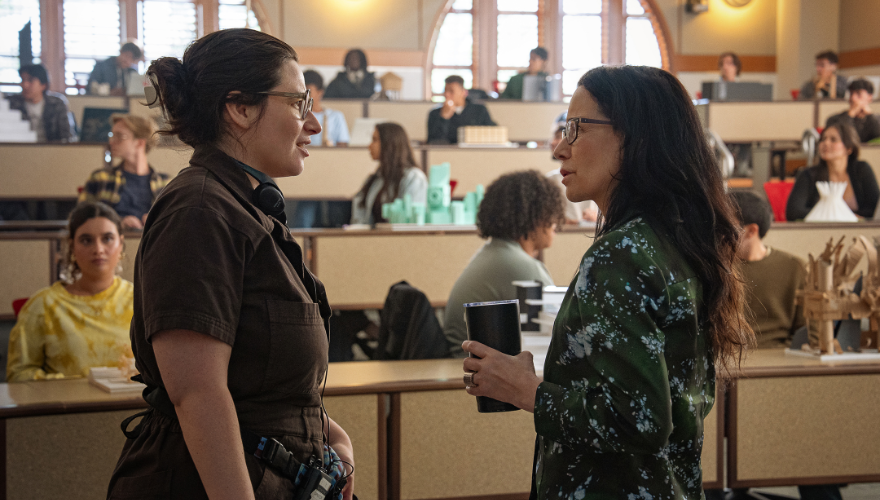
The writing partnership between Busick and Murphy is one of the more quietly fascinating creative relationships working in genre film today. Friends since the eighth grade, collaborators on Castle Rock and Stan Against Evil, and the writers behind one of the sharpest horror comedies in recent memory, they return here with something harder than a sequel. They return with a reason.
I spoke with Guy and Ryan about building that world, protecting the emotional core of the story, and the strange alchemy required to make something both funny and brutal at the same time.
This interview has been edited for flow and clarity.
Rahul Menon: The first film ends with Grace standing alone in a blood-soaked wedding dress, the Le Domas family reduced to ash, the game seemingly over. That image feels definitive. So when you sat down to write the sequel, where did the story crack open for you, and what was the first thing you knew had to be true about where Grace goes next?
Guy Busick: Ryan and I always knew that there were other Le Bail families out there. We even mentioned one in the first movie, the Van Horns. And there was a scripted but never shot epilogue in which we showed a convention hall full of Le Bail acolytes. So that got us thinking about who ran the organization, which led us to the council and the high seat and the lawyer and the bylaws.
The second thing that cracked it open for us was Mr. Le Bail's nod of approval to Grace at the end. What if that nod meant she was being given an opportunity to play a bigger game and take over the organization if she won? The idea of Grace having a chance to rule the world really tickled us.
But the most important element was Grace's journey. The thing we knew had to be true was that Grace had lost her faith in humanity and her ability to trust anyone ever again. And we wanted her to find that faith again, and find the family she always wanted. So we created a literal Faith, who was her actual family, someone Grace had lost years earlier and would be at odds with at the start. Our tagline when we first pitched the movie was: Last time, Grace was fighting for her life. This time, she is fighting for her soul.
Rahul Menon: The first part works so beautifully because it is essentially a single-location siege with one family and one target. The sequel blows that structure wide open: multiple rival families, an international power system, a throne up for grabs. How do you scale a world that dramatically without losing the intimate, character-driven engine that made the first film land?
R. Christopher Murphy: The introduction of Grace's estranged little sister Faith is without a doubt the single most important new element that helps us retain the emotional intimacy of the first film. Samara [Weaving] and Kathryn's [Newton] chemistry is undeniable. They are sisters.
When we first met Grace, we were led to believe that she was all alone in the world and desperate to be embraced by the Le Domases. Learning that she has an estranged sister, one who believes Grace abandoned her, adds a whole new layer to our heroine and what she is ultimately fighting for. Not just physically, but spiritually. We kept our focus on the sisters' frayed relationship and made sure that emotional backbone never got lost in all the action, while echoing and amplifying their conflict through our cast of villains. Sarah Michelle [Gellar] and Shawn Hatosy are absolutely chilling as Ursula and Titus Danforth, who are like a dark mirror image of our sisters. They give us a powerful counterpoint that makes Grace and Faith's arc even more satisfying.
Rahul Menon: Faith is a genuinely inspired addition, not just a new character but a structural argument: Grace has been telling herself she has no family, and the sequel immediately makes that a lie. How did that relationship develop on the page, and how did writing two women who love and resent each other in equal measure shape the emotional spine of the script?
Guy Busick: The sister relationship came relatively late in the process. In earlier versions, we tried different characters opposite Grace to build the emotional spine, including a foster sibling and a rebellious teen daughter of Ursula who decided to turn on her family and help Grace survive. None of those versions worked.
Then the Radio Silence (Matt Bettinelli-Olpin & Tyler Gillett) guys and I made Abigail, and we met Kathryn Newton, and the guys had the inspired idea to pair her with Samara Weaving because they had this similar goofball energy. When they came back to Ready or Not 2, they pitched us the sister idea, and the new wrinkle that Grace had been lying in the first movie about not having a family, and everything finally clicked. Being able to write for two actresses I had written for before, knowing all of their superpowers, made the process so smooth and fun. The emotional scenes between them are my favorite scenes in the movie. Sam and Kathryn are both so honest and funny and hurt.
Rahul Menon: Matt and Tyler have described this film as a shift from an anti-love story to an earnest love story. Did that reframe come from you on the page first, or did it emerge in conversation with Matt and Tyler, and how did it change what the script needed to do?
R. Christopher Murphy: That definitely took some time and long conversations with Matt and Tyler and our producers. We knew pretty early on that we wanted to give Grace some kind of foil and someone she might have to protect. But it took us a few drafts before we finally landed on Faith. When we first started writing, we were proceeding from the notion that Grace had been completely honest with us in the first film. But we realized we were being a little precious with our heroine. What if she had this estranged sister? How would that make us feel about Grace and what would she have to do to make things right between them? Once we started asking those deeper questions, we knew we could continue Grace's story in a meaningful way. And most importantly, we wanted to see that story as fans ourselves.
There is a clear throughline in the way Busick and Murphy talk about this film. Expansion is not just about scale. It is about complication. About taking a character who survived something definitive and placing her back into a world where nothing feels resolved. The introduction of Faith does not just widen the story. It destabilizes it in the most interesting way. Suddenly, survival is no longer the only goal. Reconciliation becomes part of the equation, and that is a far messier, far more human game.
Rahul Menon: Each rival family arrives with its own personality, appetite for violence, and relationship to the ritual. The Danforths, the El Caidos, the Wans, the Rajans: they are all hunting Grace but also hunting each other. How do you write an ensemble of antagonists that feels distinct and specific rather than interchangeable, especially when screen time is precious?
Guy Busick: This is our favorite part of the process, talking about and discovering our characters. The fact that we do not have a ton of time to define them is actually a positive because it forces us to get to the core of them very quickly. We try to make them visually and behaviorally distinct, and then give them a line or action early on that basically gives you their whole personality. Then we continue to refine them after they have been cast, all the way through shooting, as we learn the actors' strengths. We have been so lucky on both of these movies to end up with these casts. I am in awe of all of our actors.
Rahul Menon: The “paffing” is one of the great recurring comedic devices in recent genre filmmaking: absurd, grotesque, and somehow earned every time. How do you write something like that on the page, and how do you calibrate the tone so it reads as funny rather than just shocking?
R. Christopher Murphy: There is no scientific formula. It is really just one of those things that when we know it, we know it. We have been friends since the eighth grade. We were the kids who shot movies in our backyards, we were in high school theater together and even founded a sketch comedy group after we got to Los Angeles. After all of that we have basically come to share one brain and that macabre sense of humor is just baked into our collective DNA.
Rahul Menon: Horror and comedy are famously built on the same mechanics: tension, misdirection, and the precise moment of release. As writers, how do you work that out at the script level, and when you are drafting a scene that needs to be scary and funny simultaneously, how do you know when you have found the right beat?
Guy Busick: Our golden rule is that if a character is in peril, they cannot be the one to crack a joke. The stakes have to be real. The world around them can be as absurd as we want it to be, and the characters who are in relative safety can be funny people being funny. But as soon as a character in danger starts making jokes, I check out. The world is not real, the character is not real, I do not care anymore. For us, the humor has to come from the absurdity of the situation more than the dialogue. The emotional truth comes from characters reacting genuinely to the danger they are in.
That golden rule is worth holding onto. It is one of the most precise articulations of how tone functions in genre filmmaking: the joke is never the character's, it is the situation's. Grace does not find her circumstances funny. We do. That gap is where the comedy lives, and it is also where the empathy lives. Samara Weaving understands this instinctively, which is precisely why the absurdity around her lands so hard.
Rahul Menon: You both came up writing together on Castle Rock and Stan Against Evil before Ready or Not, which means this sequel is a continuation of a long creative partnership. How does co-writing actually work between the two of you, and what does your process look like when you disagree about where a scene or a character needs to go?
R. Christopher Murphy: The process is almost unconscious at this point. We have known each other for the better part of forty years and it is second nature to just trust each other. On the rare occasions when we do vehemently disagree, we resort to trial by combat.
Rahul Menon: One can clearly see a deliberate design philosophy where weapons function as status symbols, tied to when each family entered the bargain. That feels like a detail that started on the page. How much of that world-building happened in the writing, and how do you decide which mythology to make explicit versus what you leave for the audience to infer?
Guy Busick: Ryan and I have reams of notes about the council families' origins and cultures and businesses, along with who hates who and why. We over prepare in that regard. Then through development and the shoot and editing, it gets cut down to the bare minimum, which is the correct amount. We never want to overexplain or spoon feed. We want to respect the audience and trust them to fill in the blanks. Which was tricky in this one, because there are a lot of rules for this new game that have to be in there. All I have to say is thank God for Elijah Wood.
Rahul Menon: Ready or Not has grown into something genuinely beloved, a film with a real cult life that keeps finding new audiences. Now that you have extended that world, what do you hope this sequel adds to what the original meant to people, and is there something in Grace's story that still feels unfinished to you as writers?
R. Christopher Murphy: We just hope this movie gives fans of the first movie the reunion with Grace they have been waiting for. We never explicitly intended for the first one to lead into a franchise. It was always meant to be its own self-contained story. But we would be lying if we said we did not have a few lingering questions. Bottom line, we love Grace and now Faith too. They are like family to us. We are not opposed to another family reunion, but a worthy story will have to present itself first.
There is a moment in Ready or Not 2: Here I Come where the chaos pauses just long enough for something quieter to surface. Not a revelation, not a twist, but a recognition. That survival alone is not enough. That what comes after survival might be the harder thing to navigate.
What Busick and Murphy return to, again and again in this conversation, is the idea of Grace as someone still in process. Not finished. Not resolved. That is what gives this sequel its shape, even as the world around her grows louder and more crowded. The mythology expands, the rules multiply, the game becomes bigger. But the core question remains disarmingly simple: who do you become after you have already survived the worst night of your life? And what Busick and Murphy understood, after several drafts and one crucial casting conversation, is that you become someone who reaches back for the person you left behind.
The craft instincts they describe throughout this conversation are the same ones that made the original so satisfying: write for emotional truth first, let the absurdity be the world's problem and not the characters', trust the audience to fill in the blanks, and never overexplain. Those are not rules for horror comedy specifically. They are rules for good writing, full stop.
Grace is fighting for her soul this time. That is a bigger game than the one she survived before. And if Busick and Murphy have their way, it may not be the last game she plays. Neither Grace nor Faith is finished yet. And honestly, as long as these two writers are in the room, neither is the story.
Ready or Not 2: Here I Come is now in Theaters.