

Lights…Camera…Fashion! Aline Brosh McKenna Discusses ‘The Devil Wears Prada 2’
Screenwriter Aline Brosh McKenna discusses reuniting with the film’s beloved characters, her creative collaboration with director David Frankel, writing with intention, and her adaptation process.
“By all means, move at a glacial pace. You know how that thrills me.” - The Devil Wears Prada boss-from-hell Miranda Priestly (2006)
If Miranda actually walked among us, she might have delivered that zinger to screenwriter Aline Brosh McKenna for taking so long to pen the long-awaited sequel: The Devil Wears Prada 2. Then again, Brosh McKenna had no reason to reintroduce pen to paper, given how neatly she buttoned up the original.
It’s been 20 years since aspiring journalist Andrea "Andy" Sachs begrudgingly took a job as personal assistant to Miranda (Meryl Streep)—the chillingly intimidating editor-in-chief of Runway Magazine. Despite Andy’s blind ignorance of all things couture, Miranda figured the wide-eyed newbie couldn’t possibly fail worse than the parade of bulimic dimwits preceding her. She was wrong. Because in a world of stilettos, Andy’s clunky loafers just didn’t cut it—a fact she was made acutely aware of by her calorie-obsessed co-worker Emily Charlston (Emily Blunt) at every turn. When Emily gives Andy’s frumpy duds the once-over and asks if she’s on her way to some “hideous skirt convention,” it practically registers as a compliment.
It’s not long before Andy bends her knee to company culture. And with a sprinkle of makeover magic from Runway’s art director Nigel Kipling (Stanley Tucci), a Chanel-clad swan is born. But Andy’s dip in the designer pool is short-lived. After witnessing Miranda sabotage Nigel’s chance for a promotion, simply to buttress her own position, Andy abruptly returns to her journalistic roots—and her sensible shoes, landing exactly where she needs to be.
So why a sequel after all these years? For one thing, when Streep, Hathaway, and Blunt presented a 2024 SAG Award together, the reaction to their reunion was thunderous. More importantly, the media landscape seismically shifted—especially in print journalism, where battlelines haven’t just been redrawn, they’ve been obliterated.
“Twenty years ago, we were all convinced we shouldn’t do a sequel because we were happy to let the film exist on its own,” says Brosh McKenna. “But then the world started to change, allowing us to see these characters in a new light.”
So where’s our core four now? Miranda still rules Runway with an icy fist—struggling to combat sagging ad sales. But even dragon ladies have bosses. And when parent company nepo bigwig Jay Ravitz (BJ Novak) recruits Andy to overhaul the magazine’s features desk with harder-hitting content, Miranda is powerless to resist her grand return. Meanwhile, Nigel, who somehow forgave Miranda for her past rat-fuckery, is still there making things beautiful. And then there’s Emily, who defected to the retail side of the fashion divide, with a plum role at Dior. Acid-tongued as ever, at least she now eats fried food—albeit only in group settings, because “shared carbs have no calories.” Who knew?
Brosh McKenna, the brainchild behind that dietary pearl of wisdom—and a slew of other quotable gems—spoke to Andrew Bloomenthal about writing The Devil Wears Prada 2.
WARNING: SPOILERS AHEAD
This interview has been edited for clarity and length.
Andrew Bloomenthal: Let’s start with a specific question. Did you purposefully decide Emily would be working for Dior, or did you put a placeholder in the script saying, “Emily Charlston is now working at a to-be-determined luxury fashion house,” then fill in that blank later?
Aline Brosh McKenna: That's a great question! I deliberately chose Dior because for me, Dior represents one of the French temples of fashion—an exemplar of the best and the most historic. So I put Dior in there thinking it could be something else, but then it turned out we approached Dior at exactly the right time because they were actually in the middle of building their flagship location so we actually shot in Dior as they were still putting it together. There was a lot of serendipity involved.
Andrew: Related to this, at the end of the movie, Emily explains that she pivoted to Coach. When she said that, everyone in the screening room reflexively chuckled at this line. Was there some private joke that flew over my head?
Aline: I’ll put it to you this way: a Coach purse runs anywhere between $500 to $1,200, where a Dior purse could run up to $6,000, so for Emily, this is a huge come down. A $500 bag is still a splurge for 99.9 % of people, but it's not the world Emily has been in, so I think that's why people laughed.
Andrew: It’s nice to know there's deliberate intention behind every choice.
Aline: You’re a writer. You know everything’s intentional.
Andrew: In both films, you thread the narrative needle by exploring serious topics like workplace dynamics and media trends, using humor as a delivery. So I want to slingshot back to the first film. Is that kosher?
Aline: Sure!
Andrew: After watching the original, I read the Lauren Weisberger book on which the film is based, which is known for its darker undertones. For instance, Andy's best friend Lily is an alcoholic who crashes her car and lands in a coma. Tell me about pumping the brakes on those darker elemental plot points.
Aline: You know, what I did with the book for the first film—as I tend to do with all adaptations, is that I read it once, then put it down and let it filter through my brain, extracting the parts I think the film could be. There's always more meat on the bones of a book because it has more real estate, so adapting it is like pulling the skeleton out of a fish. A movie has to have a particularly strong propulsive structure, where novels can go a bit more hither and thither. So I read the book once, then put it down to do a majority of the screenwriting. But then I went back to the book to mine lines I might have missed. That’s where I found, “Please bore someone else with your questions.”
Andrew: Ha!
Aline: It was a conversation with the book, where Lauren really put her finger on something.
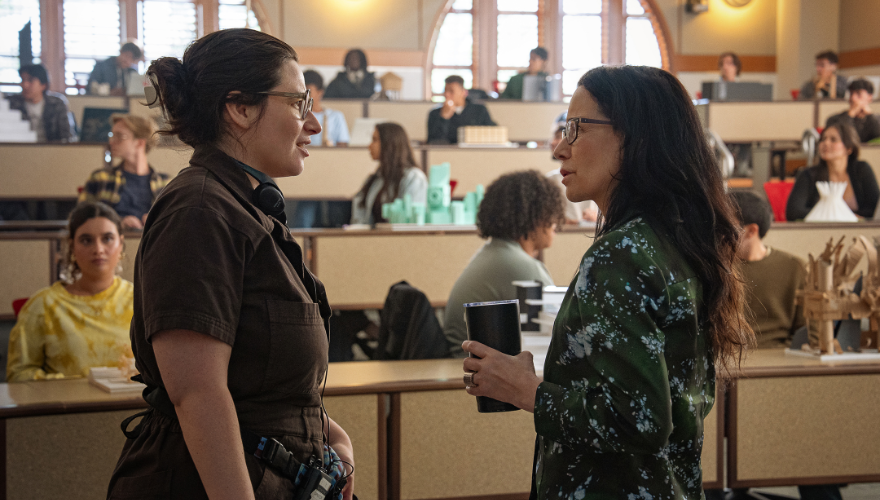
Andrew: I know that you fleshed out ideas in tandem with the film’s director, David Frankel. Did you guys rap on the phone? Or did you write portions of the script and run them by David for his gut check?
Aline: It’s funny, the first movie was built by us talking on the phone - me in LA and him in Miami. I had little kids, he had little kids, and he’d be walking the dog and hosing dog shit out of his backyard, while I was busy running errands and making baby food. And you’d think when we're building the sequel in 2026 that we’d Zoom, but we didn't. We went right back to talking on the phone like old people. Two soup cans and a string.
Andrew: And I assume you needed the buy-in of the legacy characters to write their continuing stories. Did you get their contractual obligations before deciding whose arcs to expand on?
Aline: Wait, what do you mean?
Andrew: Hypothetically, if, say, Emily Blunt wasn't interested in starring in the sequel, you couldn't write plot points for her character, right?
Aline: All of the actors were eager to see the script and didn’t sign on to the film until they read it.
Andrew: But isn't that floating in dangerous waters? Because if someone declined, wouldn’t you then have to go back to the drawing board to restructure the entire story?
Aline: None of that came up. It was all for one and one for all.
Andrew: And you said you spoke extensively with Meryl Streep after the first draft, to discuss her character, and that she offered some feedback.
Aline: True!
Andrew: What would have happened if her ideas countered your ideas?
Aline: But that’s every collaboration. You just sit down and hash things out. Meryl and I already worked together on the first movie so we have a shared language about our goals. But she always has something to say. Many things.
Andrew: I want to ask about BJ Novak’s character—the corporate honcho who was overly handsy in the workplace—always rubbing people's shoulders, and—
Aline: You mean punching people’s shoulders.
Andrew: Right. Punching. Totally inappropriate office behavior—especially in the post-MeToo era. Did you always envision BJ as the guy with boundary issues?
Aline: [laughs] The punching was definitely BJ. I mean, the idea that you’d punch Miranda Priestly in the shoulder in an avuncular way is so ridiculous—and he does it twice! I've seen the movie 7,000 times and I laugh every time.
Andrew: This next question might make you slightly uncomfortable. Did you ever consider bringing back the Nate character—maybe as a star chef who's catering one of the big events you see in the sequel?
Aline: [pause] You know, Andy’s now in her forties and she graduated from college twenty-something years ago, so I wonder how many people still have their college boyfriends in their life. I just felt that Andy had traveled all over the world and had many boyfriends, so I think she probably keeps lightly in touch with Nate, but it didn't seem like there was a purpose for him in the story. Don’t get me wrong - I love Adrian Grenier. He's a wonderful actor and a super nice guy, but story-wise, having Andy bumping into Nate for the purpose of fan service didn’t make sense.
Andrew: Finally, the world wants to know - is it true that shared carbs have no calories?
Aline: Absolutely.
The Devil Wears Prada 2 hits Theaters on May 1, 2026.
Career journalist Andrew Bloomenthal has covered everything from high finance to the film trade. He is the award-winning filmmaker of the noir thriller Sordid Things. He lives in Los Angeles. More information can be found on Andrew's site: www.andrewjbloomenthal.com. Email: abloomenthal@gmail.com. Twitter: @ABloomenthal