

Storytelling360: State of the Story Conference – Los Angeles
What a room full of Oscar winners, agents, showrunners, and one very New Jersey filmmaker taught a day of writers about the only thing that actually matters.
There is a moment near the end of every event like this one where you realize you have stopped taking notes and started just listening. That happened to me twice at Storytelling360, and both times it was because someone on stage had said something so plainly true that reaching for a pen felt like the wrong response.
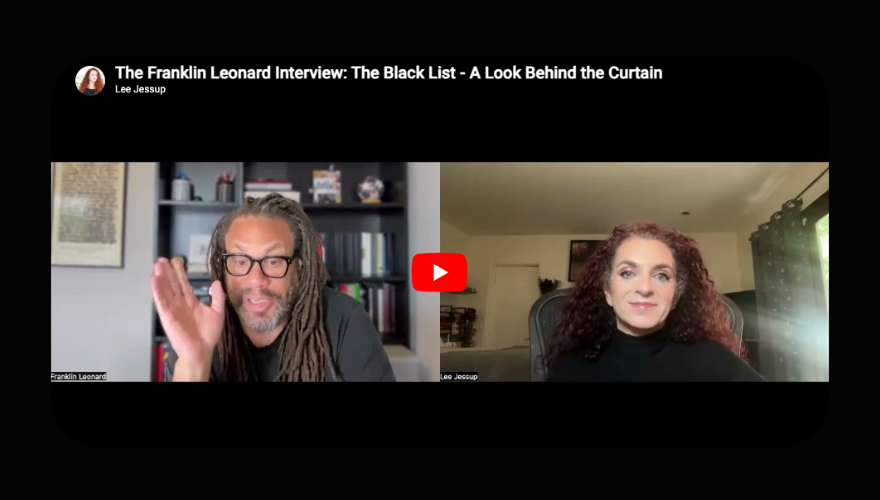
The first time was Franklin Leonard, founder of The Black List, opening the morning by doing what Franklin Leonard does best: dismantling a comfortable lie. The lie, in this case, is the mythology of Hollywood discovery. The broke unknown writer, the script accidentally in the right hands, the bidding war, the overnight success. He called it structurally satisfying and almost entirely fictional. More importantly, he called it harmful.
“More stories are being written now than at any point in human history. And the vast majority of them will never be read by anyone with the power to do anything about them. And that is entirely unrelated to their quality. The state of the story in 2026 is essentially: unread.”
Franklin Leonard
He cited McKinsey research putting the cost of industry bias against stories by Black, Latinx, Asian, women, and disabled writers at approximately $40 billion annually. Not as an accusation, but as evidence of a system running on what he called "all convention and no wisdom." Anonymous agents at Ryan Coogler's own agency called the Sinners deal reckless in the weeks before it opened. That film made $369 million worldwide and won four Oscars. His point needed no elaboration.
The NBA analogy that followed landed cleanly. The league got better every time it built infrastructure to find talent wherever that talent actually was, rather than asking the talent to come find them. When it integrated, it improved. When it went global, it improved. The last seven NBA MVPs were not born in the United States. Hollywood, Franklin argued, has never actually started trying to solve the equivalent problem. The Black List is a patch, he said freely, on something massive and structural that the industry has never taken seriously.
He closed his opening with three questions for the audience to carry through the day, and a reminder that none of it matters until the work is good enough that a stranger would pay to read it. Then he quoted Eddie Murphy talking about his comedies being played in children's cancer wards, and Tupac Shakur on the eve of his murder saying his music would not change the world, but it might change the minds that change the world.
“The system is broken by design. The infrastructure to find great writers never existed by design. The odds are not in your favor. Write anyway. Make it great. Make it entertaining. Because the upside, if you nail it, is worth it. I promise.”
Franklin Leonard
Panel One brought in the industry side: agents, managers, producers, and a development executive. The consensus on the state of the market was cautiously optimistic but clear-eyed. David Boxerbaum of Verve put it most directly: the question of buyer's market versus seller's market oversimplifies everything. Write a big commercial idea exceptionally well and it is a seller's market regardless of the climate. Write something small and self-indulgent just for yourself and there is no market at all.
Scott Glassgold of 12:01 Films made the case for the short story as an emerging and under-used vehicle for writers, sitting somewhere between the pitch and the spec, more tactile than one and more malleable than the other. He and David Boxerbaum described finding a writer named Marcus Kliewer on the Reddit forum /NoSleep, a man living on his uncle's couch on Canadian welfare, whose voice was extraordinary. They plucked him from Reddit, sold two of his short stories for over a million dollars each, and his first book sold 500,000 copies. The lesson was not that Reddit is a guaranteed pipeline. The lesson was that the work was genuinely good, and good work does eventually find its way to people who are looking.
Kate Oh, development executive at Monkeypaw Productions, put the production company perspective plainly: what makes her sit up is a singular voice with a clear, high-concept idea executed in a way that feels subversive and solely the writer’s own. She added something that rarely gets said on panels: the loosening of exclusive overall deals has actually been liberating for companies like Monkeypaw, allowing them to co-produce and work with more emerging voices rather than being locked into delivering one massive franchise film after another. For writers, that means more doors are open than the conventional wisdom suggests, provided the work has genuine identity behind it.
Adam Kolbrenner of Lit Entertainment told the Prisoners story, which deserves to be told everywhere aspiring writers gather. Writer Aaron Guzikowski sent a stamped, handwritten query letter from a leaking apartment in Brooklyn. Adam read his first script, which was not great, but heard a voice. They worked together for nearly three years across over 55 drafts, Guzikowski writing in a supply closet at work and handing pages through the door. Every agent in town passed. Then a mutual contact called on a Monday and said it was the best script he had ever read. The rest of that story has Denis Villeneuve, Hugh Jackman, Roger Deakins, and an Oscar nomination at the end of it.
Franklin Leonard, characteristically, closed the panel by asking the audience to be careful about spending money on screenwriting competitions, including his own Black List platform, before doing everything in their power to make the script as good as humanly possible first. He said this as the person taking their money. He begged them to think seriously about it.
Panel Two shifted to the craft side, with showrunner John Quaintance (Will & Grace), writer-director Hayden Schlossberg (Harold & Kumar films), screenwriter Alison Flierl (BoJack Horseman), and director Paris Barclay (NYPD Blue). The conversation moved through origin stories, the art of the pitch, switching mediums, handling notes, and the question of what anyone wishes they had known earlier.
John Quaintance's advice on pitching was the most practically useful thing said on that panel: do not look at notes, do not read something that sounds like it was written, and tell somebody the best story you have heard the way you would tell your closest friend. You are asking someone to spend millions of dollars on a luxury product. The energy of genuine excitement is what moves that money.
On moving between mediums, Quaintance described deliberately writing a horror western last year despite having no experience with either genre. His reason was simple. Once you are deeply fluent in a form, you get very good at writing it competently without inspiration. Always having one project where you have absolutely no idea what you are doing, he said, preserves the enthusiasm of a 20-year-old that is the first thing you lose when you settle into a lane.
Paris Barclay's closing answer on what he wished he had known was the kind of thing you write down and then keep thinking about on the drive home.
“I wish I had known this was going to be a spiritual journey. What I discovered through trials and tribulations is that success comes through humility. Not being less than, but knowing what you can do and what you cannot, and being honest about both. It goes back to the gift idea. What can I offer? And then I let other people do their thing. It is about giving, not taking.”
Paris Barclay
Panel Three was the one that kept the room the quietest. Cord Jefferson (American Fiction), Diablo Cody (Juno), Graham Moore (The Imitation Game), Nia Vardalos (My Big Fat Greek Wedding), and KPop Demon Hunters writers Danya Jimenez and Hannah McMechan sat together and told, essentially, the same story in five different registers: follow what you love, not what you think will sell, because you will find that everything that works came from the first category and almost nothing from the second.
Nia Vardalos performed My Big Fat Greek Wedding as a one-woman show after Paramount sent her script back, and Tom Hanks happened to be in the audience. Graham Moore's manager begged him not to write The Imitation Game on spec, a script he did not own the rights to, with first-time producers, calling it the dumbest idea he had ever heard, and then said OK, how can I help? Cord Jefferson picked up Erasure by Percival Everett at a bookstore after a devastating professional blow, was reading it in Jeffrey Wright's voice by page 100, and got the rights for free from Percival Everett himself on the condition that he pay him when something came of it. The pattern across all five panelists was the same: the thing that got made was the thing they could not not write.
Diablo Cody said it most openly: every script she has written that became a film, she wrote on spec. Every assignment has gone nowhere. She has a theory that her best work only comes from a compulsion to tell a specific story. She is sorry to everyone she has disappointed. She cannot seem to help it.
Cord Jefferson's framework for handling notes was the most precise and portable thing offered all day. Three categories: good notes, which you recognize immediately. Bad notes, which you also recognize immediately. And incorrect notes, which are the dangerous ones to dismiss: someone senses something is genuinely off, but misdiagnoses the problem. Those are the notes to interrogate, not discard, because they almost always point to something you already knew was a little sweaty in the draft and had been choosing to ignore.
The second time I stopped taking notes was toward the end of Kevin Smith's keynote. Jeff Goldsmith of Backstory Magazine was moderating, and Kevin had just described sitting in the theater for the first screening of Clerks, watching it through a lens that looked like, in his words, it was shot through a glass of milk, with nobody in the audience but his cast and ten friends. And then, about 20 minutes in, having a moment of complete clarity.
“You wanted this. You moved heaven and earth to make this happen and it did not turn out exactly the way you thought. But you now know how to make a movie. So pay off the credit cards, get a second job, and do this one more time before you leave this world. Because for the first time in your life, you knew exactly who you were when you were doing it. You knew exactly where you were supposed to be.”
Kevin Smith
He talked about his sister telling him at 21, after he saw Richard Linklater’s Slacker and said he wanted to be a filmmaker, that he should stop wanting to be it. You are a filmmaker, she said. You just have not made your film yet. He called it artsy nonsense in the moment and tried it the next morning because it cost him nothing to try. He talked about the gay content threaded through all his films, traced directly to a conversation with his brother in a car to Vancouver, learning that his brother had watched movies his whole life where nobody ever spoke in his language. He made a vow and has kept it.
He spent 32 years in this business. He described two projects that consumed two years each and went nowhere in the last few years alone, one restructured by NBC until it no longer resembled itself, one killed by a deal collapse between Paramount and Netflix. He told these stories not as warnings but as weather. The industry is contracting. The studios are making fewer movies and the ones they make are going to be sequels and remakes. He was not disheartened by this. He was energized by it.
“Where are the interesting things going to come from? Indie. It is going to rise again. I can feel it. The people waiting for something new: they are waiting for you now. They do not know what story you are going to walk in and tell them. Your voice is your currency and they are waiting to hear it.”
Kevin Smith
His closing was direct. You are not just a writer anymore. Nobody gets to be just one thing. If you wrote it, you know what it should look and sound and feel like. So why are you not directing it too. Build a team. Build a church. And when the spires break the clouds and people on the ground tell you that you are doing it wrong, never listen to them.
"You did not ask permission to make Clerks," he said. "You do not need permission for art. You need to give yourself permission."
There were probably two hundred people in that room across the course of the day. Writers at every stage, from people who had not finished a first script to people who had sold things and were trying to figure out what comes next. The specific advice varied panel to panel. The underlying message did not.
Good work is the prerequisite for everything else. Voice is the only currency that compounds. And the story that will not leave you alone is almost always the one worth telling.
Write anyway. The upside, if you nail it, is worth it.