

Dark Comedy as the Nexus of a Thriller: Park Chan-wook Discusses ‘No Other Choice’
Park Chan-wook discusses tackling adaptations, his writing collaboration process, creating tension with comedy, and more.
Auteur Park Chan-wook (The Handmaiden, Decision to Leave, Oldboy) is no stranger to blending dark comedy, the psychological thriller, and stylized violence. With his latest release No Other Choice, he morbidly ventures into the world of corporate competition and one man’s desire to survive in a world slowly changing and transforming because of AI. While Chan-wook’s notions about AI are currently neutral because he doesn’t use it himself, he says, “There are some people who believe this is a technology that will threaten mankind and we need to get rid of it immediately.”
No Other Choice is based on Donald E. Westlake’s book “The Ax” (1997) which had a French adaptation in 2005 of the same name. Chan-wook’s version stars Lee Byung-hun (Squid Game, The Match), who he’s known since they worked on Joint Security Area (2000). “We haven’t worked on too many projects since then but we saw each other often as friends. I’ve always considered casting him in my projects. Back when I first developed this film, it was planned out as an American film so I couldn’t cast him, on top of the fact that he was too young to play the role. But because I decided to turn this into a Korean film and he’s aged over the years, in fact he’s reached the perfect age for this role, I decided to cast him for the film,” Chan-wook told Script Magazine.
Man-su Means Longevity
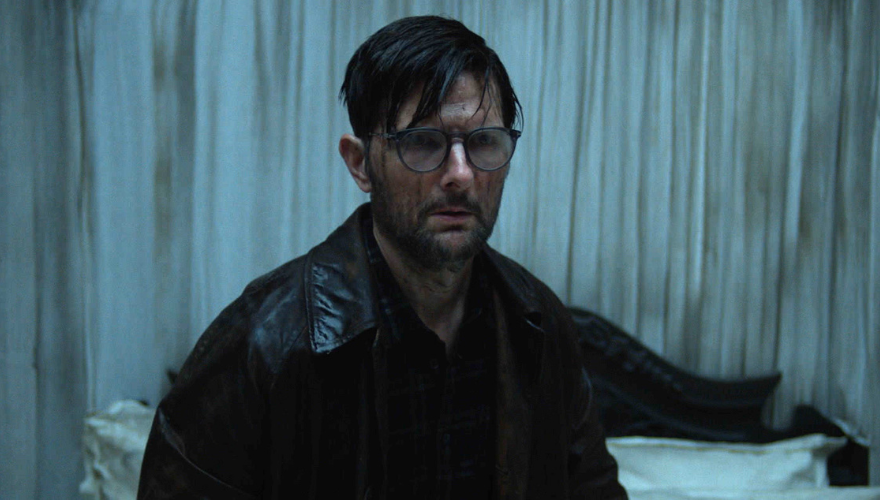
No Other Choice’s main character is Man-su (Lee Byung-hun), a man who’s at his wit’s end when he is laid off from his job at a paper company. Chan-wook crafted and adapted this anti-hero’s tale with three other writers - Lee Kyoung-mi, Don McKellar, and Jahye Lee. The award-winning filmmaker has worked with McKellar and Jahye Lee before. He and McKellar co-created and co-wrote the HBO miniseries The Sympathizer (2024). Jahye Lee was a co-producer on the show. Several long-term relationships contributed to Chan-wook’s version of Westlake’s “The Ax”.
Park Chan-wook: I worked with Lee Kyoung-mi when I was working on the first draft of the story. And after we translated that, we updated it with the American setting with Don McKellar. To make this into a Korean film, I worked with Jahye Lee, so I have three different stages of the development period. And how I work with co-writers is I don’t just throw the story out there and ask them to try it out or give them guidelines and ask them to do it themselves. We literally sit together and write together at the same time. And for all of the three writers, it’s really difficult to distinguish who wrote what because we really worked on everything together.
Sonya Alexander: How did you find investors for No Other Choice and what did you have to change about the film once you did find them?
Park: My French producer Michèle made this into a Korean film after I failed to find investors for the film as an American film.. After I changed this into a Korean film, that's when I found investors to make this happen. I started having conversations with my Korean partners at CJ Entertainment and they had no requirements or requests for me. They had liked the script even before I changed it to a Korean film. When I attached Lee Byun-ho, they had no reason to ask me to change anything since he’s one of the biggest stars in Asia.
Sonya: How difficult is it to write comedy-horror and what was the process like writing this script with the other writers?
Park: As far as the comedic elements, I didn’t approach this in a way where I already had a story and I added comedy like I’m adding spice to what’s already there. For comedy the recipe elements that are present in the film, like horror or thriller or family drama or social critique, I consider them all as one inseparable entity.
Sonya: If you were Man-su’s friend, what advice would you have given him after he lost his job?
Park: Listen to your wife’s wise words.
Sonya: What are the most important qualities of an anti-hero like Man-su?
Park: I think the most important qualification for the anti-hero is that they doubt their own judgement and actions.ted that, we updated it with the American setting with Don McKellar. To make this into a Korean film, I worked with Jahye Lee, so I have three different stages of the development period. And how I work with co-writers is I don’t just throw the story out there and ask them to try it out or give them guidelines and ask them to do it themselves. We literally sit together and write together at the same time. And for all of the three writers, it’s really difficult to distinguish who wrote what because we really worked on everything together.
Sonya Alexander: How did you find investors for No Other Choice and what did you have to change about the film once you did find them?
Park: My French producer Michèle [Ray-Gavras] made this into a Korean film after I failed to find investors for the film as an American film.. After I changed this into a Korean film, that's when I found investors to make this happen. I started having conversations with my Korean partners at CJ Entertainment and they had no requirements or requests for me. They had liked the script even before I changed it to a Korean film. When I attached Lee Byung-ho, they had no reason to ask me to change anything since he’s one of the biggest stars in Asia.
Sonya: How difficult is it to write comedy-horror and what was the process like writing this script with the other writers?
Park: As far as the comedic elements, I didn’t approach this in a way where I already had a story and I added comedy like I’m adding spice to what’s already there. For comedy the recipe elements that are present in the film, like horror or thriller or family drama or social critique, I consider them all as one inseparable entity.
Sonya: If you were Man-su’s friend, what advice would you have given him after he lost his job?
Park: Listen to your wife’s wise words.
Sonya: What are the most important qualities of an anti-hero like Man-su?
Park: I think the most important qualification for the anti-hero is that they doubt their own judgement and actions.
Perspective
Park Chan-wook has won numerous awards, including Best Director at Cannes for Decision to Leave in 2022. No Other Choice is already nominated for numerous awards, including two Critics Choice Award and three Golden Globes. Yet, all of these accolades have kept Chan-wook grounded and focused on telling a good story. He understands the art of international storytelling.
Sonya: Do you think there’s a difference between Korean audiences and American ones?
Park: I would say there was a more immediate response in countries like the U.S., the U.K., or Canada. In other words, they were laughing out loud a lot more. In Korea, I don’t think it’s because they didn’t think the film was funny. After the film, people would come up to me and tell me the film was funny. It’s just that there wasn’t a lot of laughing out loud in the theater because the subject matter felt a lot heavier for Korean audiences.
Sonya: What was your most difficult day on the set?
Park: The day where Man-su had to drink with Choi…the president of South Korea at the time announced martial law. At that time we were shooting on location at a house that was in a remote corner of a mountain. At that time, we thought it was fake news. But when we realized it was actually real, there was a sense of fear spreading throughout all of us. I’ll never forget that day. We were shooting in the coldest region of Korea and it was especially cold there because we were shooting in the mountains. I remember walking out into the cold and looking at the mountains and wondering what will happen to our country and if we’ll be able to return to Seoul.
Sonya: When you have a comedic scene, what kind of angles do you use to create tension?
Park: I think it depends on the nature of the comedy. If the comedy is funny from physicality like large physical movements or it’s the kind of humor that’s about the distance between the character and the surroundings, a wide angle would be best. But if we’re trying to use comedy based on the desperate movements of a character….a character can be so desperate that it comes off as funny to other people. If they’re relying on that, they need to show the expressions of the character. A close-up is better for that.
An example of that would be the scene where Man-su is being chased by Ara as he runs to his car swinging his arms around. Because he’s wearing rubber pants he has a very ridiculous shape and silhouette as he runs. At that time, we also see the beautiful trees. The beautiful yellow of the gingko and the red maple. A wide angle is able to capture all of this. But in contrast, where the couple is arguing after the dance party in the bedroom and Man-su is saying lines like “don’t look down on what I do,” and then he uses his finger like he’s pulling the trigger of a gun. But after his wife turns the lights on, it’s almost like just before he was about to confess everything, but with this light, he shrinks back and just mumbles everything. A close-up would be better to capture this.
Sonya: How did you initially get into filmmaking?
Park: Like other people who love film, I also grew up liking film, but I was too scared to study film in college or go to film school because I’d heard that film sets are very rough and only reserved for tough guys so I just continued to love film and didn’t pursue it in school. But after watching director Kim Ki-young’s Woman of Fire ‘82 in 1982 and three years later Hitchcock’s Vertigo, I realized I was destined to walk this path.
This Neon film will have a limited release on December 25, then have a wider release in January of 2026.

Sonya Alexander started off her career training to be a talent agent. She eventually realized she was meant to be on the creative end and has been writing ever since. As a freelance writer she’s written screenplays, covered film, television, music and video games and done academic writing. She’s also been a script reader for over twenty years. She's a member of the African American Film Critics Association and currently resides in Los Angeles.