

Finding Hope in the Vastness: A Conversation with ‘In the Blink of an Eye’ Writer Colby Day
Writer Colby Day on Mortality, Meaning, and Why Original Science Fiction Still Matters
There is a particular kind of science fiction that does not begin with spectacle, but with a question.
Not a plot question. Not a twist. But something quieter and more destabilizing. Something like: What does it mean that we are here at all?
In the Blink of an Eye opens on a cosmic scale, reaching back toward the birth of the universe itself before gently, almost abruptly, narrowing its focus to something far more fragile. A family in 45,000 BC, cold and hungry. A young academic in the present day, studying the bones of those who came before her while trying to understand her own future. A lone woman four centuries from now, floating through space with humanity’s potential resting in cryogenic suspension beside her.
Three timelines. Three emotional frequencies. One shared anxiety about time.
Watching the film, I kept returning to the same thought. This is the kind of movie that should not exist in today’s mainstream landscape. It is not built around franchise logic. It does not feel designed by committee. It feels personal. Sometimes to a fault. Sometimes to its detriment. But always sincere.
What struck me most is that beneath the big ideas, extinction, preservation, artificial intelligence, the film is wrestling with something much smaller and more intimate. How do we know anything we do matters? If we are temporary, if our civilizations are temporary, if even our species might be temporary, what is the point of loving, building, studying, reaching?
The Neanderthal segment is the film at its most confident, almost wordless in its emotional clarity. The present-day storyline is gentler, more grounded, perhaps even modest compared to the cosmic ambition surrounding it. And the future thread leans into isolation and companionship in a way that feels both whimsical and melancholic. The film does not always land every emotional beat it aims for. But it reaches. It reaches with an almost disarming earnestness.
That reaching is what lingers.
Colby Day’s screenplay, originally a 2016 Black List script, carries that ambition in its bones. It is structured with precision, yet it is driven by existential vulnerability. It wants to connect dots across millennia. It wants to believe that our smallest gestures echo.
I spoke with Colby about writing across the past, present, and future, about mortality as a North Star, and about why even imperfect swings toward something cosmic are worth taking.
This interview has been edited for flow and brevity.
Rahul Menon: In the Blink of an Eye opens with something as vast as the origins of life itself, and then immediately drops us into intimate human survival. When you first wrote this, did you always know the film had to begin on that cosmic scale, or did that ambition evolve as you started shaping the three timelines?
Colby Day: My initial concept for the film was that I wanted to write something about time, and so it felt only natural, pretty early on into the process, that it should begin with the beginning of time itself — the big bang. I also knew I wanted to play with scale of time and start with something that encapsulated a tremendous amount of history before getting into humanity’s relatively very short history in the universe.
Rahul: The film’s triptych structure feels like a bold narrative swing, three storylines separated by thousands of years, yet still emotionally rhyming with each other. When you were building the script, what was the connective tissue you kept returning to that helped you stitch everything together?
Colb: My goal was always to find a way to tell a story that would encapsulate our past, present, and future. The thing that most interested me about getting to write characters in all three timelines was trying to balance the fact that our emotional experience might remain the same, even as the complexity of our lives and circumstances would evolve. So the balance of the structure with some way to tell emotionally true stories within it was always sort of my North Star.
Rahul: In my review, I wrote that the film feels rare in today’s mainstream landscape because it does not play like it was designed by committee. It feels personal. What was the original emotional impulse behind the script for you, the deeper human question you were chasing beneath the science fiction?
Colby: That’s so nice! I don’t feel like I usually know when I start writing something why I’m doing it, and only once I have a first draft can I start to self-analyze a bit. I started writing this while living alone in New York, quite depressed, trying and failing to force my career to mean something, and at the same time I was reading all these books about the scale of the history of the universe, and early human evolution.
It makes sense to me now that what I was asking was “how do we know anything we do matters?” Our time here is so short and I think I was trying to answer for myself “how do we as single people impact those who come after us? Can we even?” Perhaps a bit of an existential crisis made manifest in screenplay format. Not what a conference room in Burbank would necessarily gravitate towards, certainly. But I do think universal anxieties, absolutely.
There is something disarmingly honest about that admission. The script did not begin as a calculated high concept pitch. It began as a personal reckoning. And perhaps that is why, even when the film reaches ambitiously toward its biggest ideas, it never feels cynical. It feels like someone thinking out loud across millennia.
Rahul: The Neanderthal storyline is easily the most striking and visually powerful section of the film, and it carries an emotional weight without relying on dialogue. On the page, how did you approach writing something so primal and visual without it becoming overly descriptive or literary?
Colby: It’s funny, the script does very little of the lifting in terms of literary writing. My scripts tend to be very casually written, they’re definitely not traditional in the Screenwriting 101 sense, but they’re not particularly flowery either. I’m just trying to tell the reader everything I think they need to know. I knew we needed to understand what our characters were thinking and that would be all we’d be able to convey to the audience. So I really just wrote English dialogue in brackets with a note at the top of the script saying “We may not hear any of this as dialogue, and we definitely don’t need to understand any of it. Just trust me, it’ll work.” I always want to give actors a tremendous amount of room and flexibility, since their faces tell so much of the story, and so I knew if we could just know our Neanderthals were thinking, even if we didn’t quite know what, it would be interesting.
Rahul: One of the most fascinating things about the film is how it treats ancient people not as distant history, but as real human beings with recognizable love, fear, and exhaustion. Was it important to you that audiences see them as emotionally familiar rather than exotic?
Colby: Absolutely. It’s very easy to flatten the past, and imagine it as having been simpler. The problems, the people, the emotions. And so I really wanted to bring an audience back, while keeping the emotions at the fore.
When the film cuts back to that prehistoric world, it feels like returning to its emotional core. No speeches. No overt philosophy. Just fire, hunger, family, and the thin line between extinction and tomorrow. It is in those sequences that the film’s thesis becomes quietly radical. We have always been this way. Afraid. Loving. Trying.
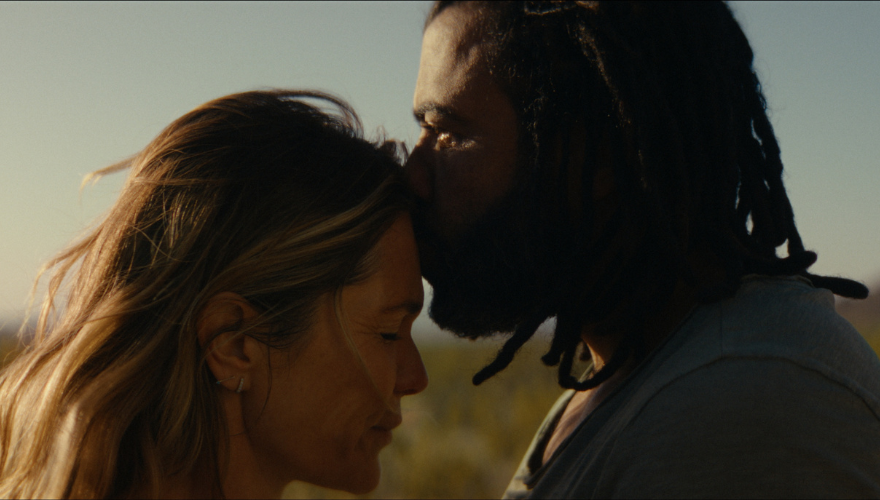
Rahul: The present-day storyline with Claire (Rashida Jones) and Greg (Daveed Diggs) has a quieter, more grounded tone, but it carries the film’s philosophical backbone through anthropology and the study of what remains. What drew you to using an academic lens as the modern bridge between past and future?
Colby: I really just think I was interested in the history myself. I love science, I love history, and I love the pursuit of better understanding our place in the universe. But I also think there was clearly a deeper emotional meaning at play too. Claire is focused on the past with her work, and her sort of inciting incident in the film causes a sharp focus on the future when she learns her mom is sick. It felt interesting to me to have this character who couldn’t focus at all on the present because she was so pulled in both directions.
Rahul: There is a poetic idea in the film that we spend our lives building meaning, only to eventually become artifacts ourselves. That is a haunting thought. Was mortality always the core theme for you, or did the story begin more as a sci-fi concept and then deepen into something more existential?
Colby: Mortality all the way! When you really contemplate the scale of human life as it relates to the cosmic scale of time, it can be terrifying. I don’t recommend doing it very much. And there’s a nihilistic way of looking at that smallness, but I also feel that, for me, it makes the human experience all the more wonderful. That we exist at all is so very lucky! So I was very conscious of wanting to craft a story that could live within that tension. We are small, and yet! This is cheesy, I know, but I do think the cheese is supported by the science.
It is that tension the film keeps circling. We are small. And yet. The screenplay never quite lets cynicism win. Even at its most philosophically ambitious, it remains grounded in something tender. It wants to believe that the mundane moments matter as much as the cosmic ones.
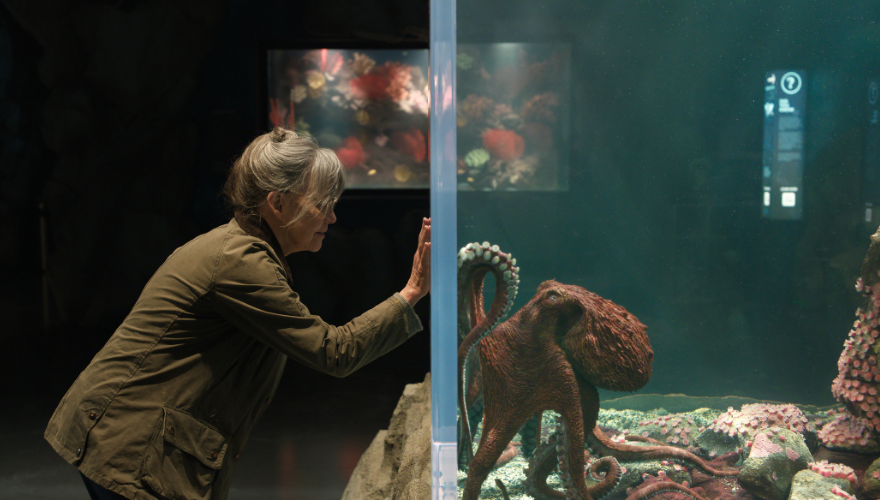
Rahul: The future storyline leans into a chamber drama tone, almost like a quiet psychological survival thriller set in space. What excited you about placing Coakley (Kate McKinnon) in such an isolated environment, where the conflict is not just external, but internal and emotional?
Colby: I never thought of Coakley as alone, not really, since she had a companion in ROSCO. But she is very much alone in human terms, and she is very much alone with the weight of the consequences of her actions, as someone carrying a possible future for humanity with her. You can map the three timelines onto human development too. The past as infancy, exclusively focused on survival, the present as adolescence, focused on differentiating and defining oneself, and the future as adulthood, which is the first time we really become more concerned with the consequences of our actions on the future.
Rahul: Kate McKinnon is such an unexpected but inspired choice for that role, because her comedic voice is so specific, yet the character carries genuine loneliness and exhaustion. When you were writing Coakley, did you hear humor in her voice from the beginning, or did that tone sharpen once McKinnon became part of the film?
Colby: I can’t help but write characters who make jokes. People are naturally funny, even and especially in the most dire of circumstances. But there’s clearly something about comedians playing against type and getting to be more dramatic that’s very exciting to me. I keep doing it, whether with Kate, or with Sandler. I’m drawn to people who are funny, and I think it’s one of our best coping mechanisms, certainly mine!
Rahul: ROSCO, the ship’s sentient system, becomes more than just a sci-fi device. There is something quietly moving in the way their dynamic plays out. How did you approach writing an AI presence that could feel emotionally resonant without turning it into a gimmick?
Colby: I knew I wanted Coakley to have someone she could talk to. But when you get into the science of space travel, it very quickly becomes impossible to have live time conversations with anyone who isn’t onboard with you. But I also wanted her to be alone. The idea of an artificial companion felt like it encapsulated that tension perfectly. I knew I wanted to write a very different version of Artificial Intelligence. I wasn’t interested in writing a Hal 9000 type, and I wasn’t particularly interested in our present day chatbots. What I was interested in was consciousness and companionship. What makes something think? What is thinking? And is it just in our nature to crave connection, even if it means needing to build it?
The future thread expands the film’s tonal range, but its heart is unmistakable. Even in deep space, even surrounded by technology, the question remains the same. Who do we talk to when we are afraid? And what does it mean if something talks back?
Rahul: The film explores sweeping sci-fi ideas like longevity, extinction, and artificial intelligence, yet it keeps returning to emotional simplicity. How did you ensure the science stayed in service of the human story rather than overpowering it?
Colby: The big ideas drew me to the premise, but I never want to make something that’s just about an idea. For me it always begins with an emotional story that connects with me first, and hopefully with an audience. The larger concepts exist to serve those smaller, intimate human experiences.
Rahul: The film juggles multiple timelines with impressive clarity. When writing, did you already have a strong sense of its pacing and intercutting, or did that structure evolve in the edit?
Colby: In the script I was very rigid about moving from past to present to future in that order. But even then, the timelines were designed to wash over one another through sound and visual cues. It made sense that Andrew (Stanton) and editor Mollie Goldstein would lean into that and find even more fluidity. The script is only the starting point. Each stage of filmmaking reveals something new.
Rahul: Your script was a 2016 Black List selection and has now gone on to win the Alfred P. Sloan Feature Film Prize at Sundance, directed by Andrew Stanton. Looking back, what did that earlier version of you get right, and what do you understand now that you didn’t then?
Colby: What I didn’t know is probably what made it work. I wrote it without thinking about whether it was producible. Once it landed on the Black List, I was confronted with the practical limits of the industry. But if I had focused on those limitations, I never would have written something so expansive. I hope to hold on to some of that naïveté. With enough creativity and trust, almost anything can be brought to screen.
Rahul: Andrew Stanton is known for crafting wonder, loneliness, and hope. When he came on board, what shifted most in your relationship to the script?
Colby: At our first meeting, Andrew pointed to a moment in the script and asked, “Why does this happen?” It was a lightning bolt. His desire to understand every beat was reassuring and pushed us into rigorous story logic. We did that kind of story math throughout. He wanted clarity first for himself and ultimately for the audience.
Speaking with Colby, what lingers is not the scale of the ideas, but the sincerity beneath them. Time stretches across millennia in the film, yet every answer returns to something intimate and fragile. In my review, I wrote that even when it reaches, it reaches toward something real. That impulse feels present in its origin story too. The vastness is cosmic, yes. But the heartbeat is stubbornly human.
Rahul: As a writer, how do you personally define success for a film like this? Is it about narrative satisfaction, emotional resonance, or simply the act of daring to swing big?
Colby: Obviously we all want to make a fundamentally perfect object. But those are quite rare, and so short of that I’d so much rather try for something daring, taking a big swing, than play it safe and small. I feel that way as both a filmmaker and as a filmgoer. Hollywood obviously exists at the crossroads of art and commerce, but it is an art, and I’d much rather experience art that is personal and potentially imperfect than something that feels mass produced or without care. That being said I do intend for my next film to be perfect.
Rahul: One of the most moving things about In the Blink of an Eye is that it is fundamentally hopeful. In a time where sci-fi often leans bleak and cynical, this film feels like it still believes in connection. Was it important to you that the film never betrays its own sincerity?
Colby: I vacillate wildly day to day from “we’re so doomed” to “maybe we’ll figure it all out.” I very much have a cynic in me. But I do believe in people. Through many many many years of humanity we have somehow miraculously kept ourselves alive, and I hope that we can continue to do so. I don’t know how we’ve managed so far, but I do think it’s important to hold on to hope while continuing to take every action we can for good.
Rahul: Through your blog Hollyweird, you’ve become an unofficial guide for emerging writers. It’s rare to see a working screenwriter so candid about the process. What pushed you to start writing those posts, and did you realize how meaningful they would become for writers who feel locked outside the industry?
Colby: That’s so nice to hear. When I was in New York trying to break in, Hollywood felt like a black box. I had no one to ask how things worked. The newsletter began as an end of year reflection on “My Year as a Working Screenwriter” because I didn’t know if what I was experiencing was normal. When so many writers responded saying, “Yes, this is exactly what it’s like,” it felt reassuring. Being honest about rejection and how hard this career is felt like a small public service. It grew from that desire to demystify the process and let people know they aren’t alone, good and bad.
Rahul: You’ve said you’re shy, which is surprising given how bold your work feels. Is writing where you feel most fearless?
Colby: Absolutely. I’ve always felt safest exploring emotions through storytelling. I’ve never felt embarrassed or unable to be myself on the page. Writing is a sanctuary, and I think many writers feel that way.
Rahul: What’s a film you return to when you need to remember why storytelling matters?
Colby: Singing in the Rain. It’s impeccably constructed, miraculous at scale, visually gorgeous, and still timely. Movies are always dying and always reinventing themselves. And more than anything, it’s just pure fun.
Rahul: And finally, after writing stories that involve time, loneliness, and the ache of connection across impossible distances, what is the next strange monster, ghost, or chaos theory obsession pulling you forward?
Colby: Ha! My main obsession at the moment is preparing for my feature directorial debut, The Comedy Hour. It’s a dark showbiz comedy about the end of the world, corporate consolidation, and why we keep making entertainment while it feels like the world around us is burning. Easy stuff to tackle! I also really do want to make a ghost movie! You have my taste down!
In the Blink of an Eye is a film that dares to stretch, across centuries, across ideas, across the fragile space between survival and hope. It does not hide its ambition. And in speaking with Colby Day, it becomes clear that the film was never about crafting something airtight. It was about crafting something felt. It was about reaching for meaning in the vastness.
There is something admirable about that. About a writer who begins with cavemen and space, and ends up wrestling with mortality, connection, and hope. About a film that risks being earnest in an era that rewards irony.
When I wrote that "the movie feels like a reminder of what original science fiction can still be," I meant it. Not flawless. Not airtight. But ambitious. Heartfelt. Interested in the human experience.
We are small. And yet.
In the Blink of an Eye, we love. We build. We reach. And sometimes, if we are lucky, those echoes travel farther than we think.
In the Blink of an Eye will premiere and stream on Hulu on February 27, 2026.