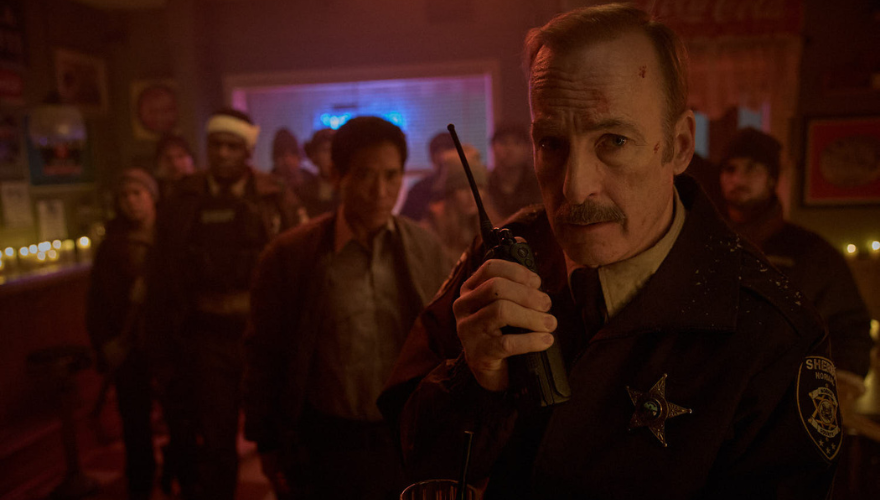


Rian Johnson on Crafting Character First Mysteries
Rian Johnson talks about the craft of screenwriting in the context of his most recent film.
Rian Johnson has lately made a career of the mystery film. After his incredible work on Star Wars: The Last Jedi, the eighth installment of the blockbuster mythology of the Skywalker saga, he turned his gaze toward the saga of Benoit Blanc, gentleman sleuth, played by Daniel Craig. With 2019’s Knives Out, he created a phenomeon. Followed up with 2022’s sequel Glass Onion and two seasons of the critically acclaimed, Columbo-inspired mystery show Poker Face, he’s now released Wake Up Dead Man, the third film in Benoit Blanc’s ongoing repertoire.
Each film in Blanc’s case files are different, casting Blanc as a supporting character, and each has a tone on its own. For Wake Up Dead Man, Johnson turned to his own experiences with religion, adopting a less comedic approach than the previous two installments and grappling between the poles of Kurt Vonnegut’s humanism and Graham Greene’s struggle with religion. It’s a moving film with fascinating, living, breathing characters at its core. Rian Johnson is one of the great screenwriters of our time and his films worthy of analysis the same way one might go over William Goldman or Lawrence Kasdan.
We were fortunate enough for him to allow us some time to talk about the craft of screenwriting in the context of his most recent film.
Bryan Young: The last time we talked for SCRIPT Magazine, we spoke about where you start with theme, or that place where you start. For Wake Up Dead Man, where was that starting place?
Rian Johnson: It kind of started in my head. The challenge for myself was whether I could make a big fun Benoit Blanc mystery and not just have the theme of faith be hidden underneath that, but actually use a big Benoit Blanc mystery to engage with the theme of faith. So it started with me tapping back into my own personal experience with faith.
I grew up very Christian, very Protestant, evangelical. I basically grew up a youth group kid. I was deeply Christian up through my early 20s and then I fell away from the faith in my 20s and I don't consider myself a Christian anymore. Everything that's kind of wrapped up in that, there's a lot of complicated stuff going on for me.
The first step was digging back into that part of my life and also engaging with the things that I hear from faith that still fuel me today and the things that I didn't like so much about my time in the church and seeing if I could have a multifaceted conversation about it.
BY: That was something I really responded well to and had really enjoyed. Graham Greene talked about how he’d write his serious novels and his entertainments. This felt like a split down the middle between the two. Where it's as much Ministry of Fear as it is Power and the Glory.
RJ: Yeah, yeah, yeah. I appreciate that. That was the challenge of it. That was the intent.
BY: Obviously, you're going for the mystery vibe, but there is a lot of that Graham Greene exploration of faith in there. Father Judd feels so much like the Whiskey Priest.
RJ: Yeah. There’s Greene. There's also another British writer who wrote genre, but was very engaged with faith in different ways, G.K. Chesterton and the Father Brown mysteries, which I don't know if you've read those, those are highly recommended. I reread all of those. I'm a fan of Chesterton's work anyway. The Man Who Was Thursday is an insane novel. It's beautiful. But the Father Brown mysteries are almost like the template for this in terms of engaging with with serious moral questions in the context of a very genre story about a priest-solving mysteries.
But the priest, Father Brown, is a great character and he, you know, the center of him is that he is good at being a detective, not because he understands the perfect and divine, but because he understands the messed up nature of humanity. And he has a genuine sort of—he’s made it where he has a non-judgmental attitude towards it.
I've read a lot of Graham Greene. I'm a big fan of his because I could see that connection. I would say that Father Brown mysteries were even more of an influence.
BY: Since you came out of The Last Jedi, mystery seems to be your bread and butter, whether it's the Knives Out mysteries or whether it's Poker Face, and even before that, obviously, you were sort of very much into that, whether it's Brick or Brothers Bloom, even Looper has elements of that. As you're designing a mystery for film, and you're working from theme, and you're sitting down to work at your typewriter, as it were, trying to build the mystery, but you're working with characters and trying to tackle faith, how do you go about structuring those things together?
Do you work on building the mystery first?
Do you work on building the characters?
What order do you work on that as a screenwriter?
RJ: You know, the answer I give will sound kind of clean as you and everyone who writes know, there's no such thing as a clean process, so it is all kind of happening at once. Very broadly, I would say the thing that I start with, or really try to start with, is the basic spine of the movie, which is essentially, “who is the main character?”
What do they want?
Why can't they get it?
And then what's the shape of the movie as defined by the way that they get it in an unexpected way at the end?
And that basic fundamental kind of backbone of any good story.
All the other stuff can be brewing and obviously the notion of theme is very much engaged with that question of “What is this spine?” but that's the thing that actually start with that defines the shape of it. “What is the journey of the protagonist going to be?”
Then I build or slot in the mystery elements to serve that journey.
But I've learned that the mystery elements, as fun as they can be, the process of that is not actually going to be entertaining for an audience. I mean, it's fun, it's entertaining to watch, but it's not going to hold an audience. It's not going to involve an audience, I should say. It can interest an audience. Not going to involve them. The only thing they can do that is, you know, the fundamentals of a character's journey.
So Father Jud is really where this starts and ends.
BY: Does that make that difficult in that these are “Benoit Blanc” mysteries? Because he’s an ancillary character…
RJ: No, not at all because that's how the other two have been built. The reality is that he's not the protagonist in any of them. I think, in his role as a detective and also as the main kind of companion and foil to the protagonist, to Jud in this movie. He’s critical to the film, he’s still part of the engine that makes it run. That’s another thing I feel like struck on early, just that Blanc can't be the protagonist, he can't be the main character. He always has to be supporting the main character in some way or foiling them and working them against them or has to be an obstacle, they have to overcome. I actually think that's quite important into making these things tick.
BY: That makes sense when you think about a lot of mystery fiction. That goes back to Conan Doyle, where Watson's always the point of view character, never Holmes.
RJ: 100%. And even in Christie. You're never really watching the movie through Poirot, or reading the book through Poirot's point of view. Whether Hastings is involved in it or some other character. In Murder of Roger Ackroyd, there's a small town doctor who he partners up with. I mean, there's always, I would say there's generally, 90% of the time, I think another pair of eyes we're seeing it through. First of all, that lends the detective a bit of a mystique, and also because the detective is really paired with the process of the mystery.
So, again, if you are making a movie and deciding at the outset that you're not, that the process of the mystery is not, the engine that's driving the car dramatically, that means the detective is not going to really be the engine. He's going to be engaging with the actual driving force.
BY: One thing that's been interesting to watch with all three of these movies is how the structure folds in on itself. I'm wondering, sort of what your philosophy is on that or or how you approach that. Is that something that just comes naturally with the process?
RJ: You mean in terms of like the time jumps or…?
BY: The time jump, or with, in Knives Out, you have that overlapping where, where the murder’s already occurred and they're interviewing everyone, so you’re doing triple duty, introducing characters, the murder, and everything all at once. With Glass Onion, you go through everything twice. With Wake Up Dead Man, you have the letter of his confession. It’s specific to each film.
RJ: I do think that, for example, a lot of it is trying to use whatever advantages film language gives me to help me out with what are some of the more difficult things about writing one of these mysteries.
With Knives Out, the fact that with film, we can hop around and we can overlap stuff and we can flash back and see different things pretty easily. That means a lot of the legwork that is the hardest part of setting up a mystery like this, which is the first act meeting all the suspects and getting a sense of who got killed and why and all of that. That means you can present that quicker and more clearly to the audience if you take advantage of that.
Or with Glass Onion, that was kind of baked into the conception of the thing, the idea of, “Can I pull off something where there's a hard reset in the middle and we see the same sequence of events, but the second time we see it, it genuinely changes the perspective we're seeing it through and reinforms it and amps it all up.”
With this Wake Up Dead Man, the Murder of Roger Ackroyd-style framing device was kind of inspired by… well, I knew that I was going to give that first act to Father Jud and that Blanc wasn't going to enter until the end of the first act. That seemed important, just because of the complexity of who Father Jud is and his conflict with Wicks and the whole thing with the church. I felt like giving him that real estate would be really important, so the audience really understands his conflict before the juggernaut that is Benoit Blanc enters the story with his own gravity.
There was also, honestly, something that got me excited, was inspiration from the Sondheim show Into the Woods, which has the first act narrated fairy tale wise by a narrator and then—not to spoil Into the Woods for anyone—but in the second act, the characters get sick of the way he's telling the story and basically feed him to the ogre, and then suddenly there's no longer a narrator and the story is off the rails and they're into the woods and don't have a clear path. It feels like it could happen.
I liked that idea of the voiceover providing almost this safe comfort for the audience of, we're being told this story by Father Jud. And then once that's over, the notion of, “Oh my god, anything can happen now!” where we're off of the track, as it were.
BY: It felt structurally a little bit, and I know you're a fan of Columbo too, right? Where it's just like, here's how everything's going and then Columbo comes into unravel things.
RJ: It is a little. I mean, look, I've done backflips in the first two movies to avoid doing this, but this is a little bit more of a traditional Whodunnit structure. You’re right. The How-catch-‘em structure has that too.
But in a lot of Christie's books, the first 30 or 40 pages are setting up the town, meeting all the suspects, getting a sense of who gets killed.
Maybe you hear about this strange little Belgian guy who's moved in across town, but it's not until the murder happens and at the end of the first act, really, that he shows up. So in that way, I thought, well, there's a little bit more traditional structure and it’ll suit this well.
BY: Not to say that that Wake Up Dead Man doesn't have its funny moments, but it's definitely more serious in tone than the 1st two.
RJ: Yeah.
BY: Was there a concern on your part or was there any worry as you were writing it that it would feel like a little bit of a left turn for a Benoit Blanc mystery or was there just a confidence on your part thatBenoit Blanc mysteries could handle that bit of swerve?
RJ: I mean, I hesitate to use the word confidence, especially to another screenwriter who knows we're never confident. We're always swinging at a piñata with the blindfold on to some extent and hoping that it’ll work. Hoping it connects.
But I'll say this: it was important to me that.. I guess to me, the danger I potentially saw in coming out of Glass Onion, which was—I love that movie, it’s exactly what we wanted to make, a very Last of Sheila-esque, big, broad vacation comedy, that’s is part of the reason why I wanted to make the next movie right away and dive into it as opposed to doing something else first—I could see if the audience thinks this is a graphed trajectory they think that from Knives Out to Glass Onion this is just the slope that the series is going to continue on. And it's just going to be another big fun destination movie and going to get bigger and broader with each one and be a comedy.
For me, I wanted to show to myself also and to prove to myself that, no, these movies can really be anything.
And not only that, but in that case, to let me take one of these movies and try to genuinely dive into one of the most deeply personal things in my life and see if it can hold that and handle it.
I can't imagine ever making anything that didn't have humor in it, and wasn't funny to some degree, but I definitely also felt like it was a feature, not a bug that it toned the wackiness down a bit and then engaged on a more grounded level.
BY: I definitely see what you're saying in that. There's an alternate universe where the Knives Out Mysteries could have gone the direction of the Pink Panther movies where Glass Onion is as sharp and as great as A Shot in the Dark, and followed Peter Sellers and Blake Edwards down their path.
RJ: And look, that could have been that, that could have been fun. And that's the other thing. Down the road, maybe we'll have one that's totally more comic again. But I wanted to show that it's not necessarily gonna just continue to be that.
And also, honestly, that these movies are not going to just be defined by a big glamorous destination. It’s not going to be like, “Oh, the gang’s going to Paris this time. And, oh, this one's in Alaska!”
The notion that, OK, no, this one is a small town mystery.
What defines it is the tone and the characters and the type of mystery it is.
BY: I want to ask about your writing process in general, from conceiving the idea to actually getting it onto the page, what's your typical writing process?
RJ: It’s a mess. [laughs] No, I work in notebooks. I work in little pocket size moleskin notebooks and I work in those notebooks for the first, maybe, 80% of the process. And that's a combination of just free writing, talking myself through the theme and characters and ideas and big picture ideas and details, sometimes I'll draw shots if I come up with them.
But the big thing I'm doing in those is working towards kind of the graphic outline of the movie.
The way I do it is I'll draw a line across the page, which is like 5 inches long, these small pages, and then I'll cross hatch it, and kind of just lay out for myself visually the, a map of the movie on the timeline.
It helps me, especially with these movies, to start there and to develop in that space as long as I can, because in this form that can tend towards complexity very easily.
Being able to hold the simple arc that we talked about, to literally see it visually in one visual gulp on one small page, helps me stay connected to the simple spine of the thing.
I find it really useful to stay in the notebooks forever. And then inevitably, I stay in them too long and end up, going, “OK, it's time to type pages.”
And then I look at the calendar and realize I'm 3 months past the deadline I told my producer, I'd have it by, and then I panic and start writing.
BY: When you actually get it into the computer and have a script draft, do you iterate drafts a lot between having a first draft and then going to shooting? How many changes do you go through between that part of the process?
RJ: A lot and more than a lot on this one. This one was a beast. This was the hardest thing I've ever written. And I rewrote it more than anything I've ever written.
And this is after doing the whole outlining process, and after laboriously planning the whole thing out, I would say, even after that, I probably went through 20 to 25 drafts of it. In that first act, I think I have literally five or six complete throwaway drafts of the first act that were totally different. Because the first act is always the hardest part. Even with all of that planning.
That doesn't save you from writing being rewriting, but it does give you a basis when you're rewriting to go back and reference and look back at your map and say, OK, where did I go wrong here? Or to say, this sunk into the swamp of complexity, let's go back to the map and see if there’s a simpler way to connect these two nodes on the line?
BY: What are some of the things that caused some of that rewriting? I’d talked to Tony Gilroy about Andor and he’d said some of their rewrites in the room were production design sorts of things. What sort of things are causing some of those rewrites as you get closer to production or even in production?
RJ: For me, it's more fundamental than production considerations. I can only imagine logistics with something like Andor. And also the budget limitations, even if you've got a very healthy budget for something like that.
For this, because it is more limited, because there are essentially, like four or five main sets, and there's really one big main set, which is the church, and because we were putting all our eggs in that one basket, and so much of the movie takes place there, I could design that just to the needs of what I wanted.
So most of my I rewriting came just from it not working on the pitch, just from feeling like it was working. Sometimes clarity, although that's always the easiest thing to fix. The bigger thing was tone.
Especially in regards to the religious elements if it was didactic or finger-waggy one way or the other, which, in the beginning, it kind of did, and I kind of realized that came down to how I wrote Father Jud. I realized it wasn't working because I was writing him from my perspective right now, and I had to kind of become a method actor and really put myself back to when I was a believer and really put myself back to seeing through those eyes in order to write Father Jud in a way that felt honest.
BY: What about writing in the editing room? How much changed from that shooting draft to the editing room?
RJ: It’s a great question and there's no simple answer for it, except that the editing is, for me, the completion of the writing process, absolutely.
But it's also, I don't know—with these movies, one thing that you don't end up doing is shuffling in a big way in the edit. With other genres, even with The Last Jedi, the way that happened we’d say, “Wait a minute, we move this over here, this thing where we're intercutting these storylines, if we connect this up over here, that'll work better.”
You don't really do that in these movies just because it is a little bit more linear and locked in with the mystery narrative.
What you do is be shocked at what you can cut. Pacing is always what you're fighting and clarity to some degree, but usually clarity in the edit means you have to clear out some clutter.
So it means, OK, we don't set up five things to set them up to pay them off at the end, we just pick these two which are important and cut those other ones out and suddenly you start thinking in terms of what is your real estate. Not even in terms of screen time, in terms of audience attention and the amount of brain power you're asking the audience to spend tracking all this stuff.
So, anyway, that’s a long rambling way of saying the writing absolutely continues into the edit.
BY: Is there anything in the edit you feel like you lost that you were really excited about in the writing?
RJ: Oh yeah, absolutely. But that happens every time.
Especially if you're excited about something in the writing, it's generally a bad sign. It's a sign that that's what's going to end up getting cut. David Mamet talks about the “audition scene,” and there's always a scene that's like a beautiful monologue that completely defines the character, and it's usually the scene the actor will use to read and audition for.
It's the reason they got the part.
You'll leave it in the movie and be in love with it and then you'll get to it in the edit and realize you always have to cut the audition scene. Not because it's not good, but because it inevitably is stopping to explain to the audience something that they need to be understanding on a more basic, less wordy level.
There was definitely one of those in in this movie where there was a longer monologue one of the characters had, and that character did it so beautifully, and I ended up in the edit just very late in the process. I literally went, “oh, wait a minute, this is the audition scene.” Ended up cutting it down to maybe just 20% of what it originally was, and it was so much more powerful for the character.
So, yeah, that just happens.
BY: What advice do you have for screenwriters, especially screenwriters that are looking to do mysteries?
RJ: I’m always hesitant to phrase anything as advice. One thing that I guess I have to keep relearning on every script but ends up being the guiding principle—and we've talked about already in our conversation is, especially with the mystery forum—you can't mistake the reveal of information for a dramatic turn. And you can't mistake surprise for dramatic climax.
Clue gathering and process, it's fun and it seems like it's the stuff that mysteries are built out of. The reality is those have to be ornaments you hang on the tree. You need to always be thinking in terms of story, story, story, and that means, who are you invested in?
Why are they in trouble?
Why is the audience leaning forward, wondering if they're going to get out of it?
You have to be building a roller coaster ride for the audience in every single scene, as opposed to building a crossword puzzle for them to solve.
BY: That’s why I really loved that moment with Father Jud and and Benoit Blanc when they're trying to call about the tomb. I think that's the scene, more than most, that reminded me of Power and the Glory where it's like, “I need the information that's going to clear my name, but you need a priest now,” and it's such a great character moment, and it overrides all the clue gathering.”
RJ: But also it's interesting because in a way, it looks like the story is slamming to a halt there. I think the reality is, if you look under the hood, the opposite is happening there, where it's a big dramatic change that happens, and suddenly it’s… different. I don't know. That’s what you always have to be focused on. What is the reversal happening in every scene, you know?
BY: Exactly.
RJ: Yeah, I feel like we could just, you and me, we could just talk all day about screenwriting, man.
BY: Yeah, no, I'd love to.
Wake Up Dead Man is still in limited theatrical release, but also streaming on Netflix.

Bryan Young is an award-winning filmmaker, journalist, and author. He's written and produced documentary and narrative feature films and has published multiple novels and a non-fiction book. He's written for Huffington Post, Syfy, /Film, and others. He's also done work in the Star Wars and Robotech universes. You can reach him on Twitter @Swankmotron or by visiting his website: swankmotron.com.