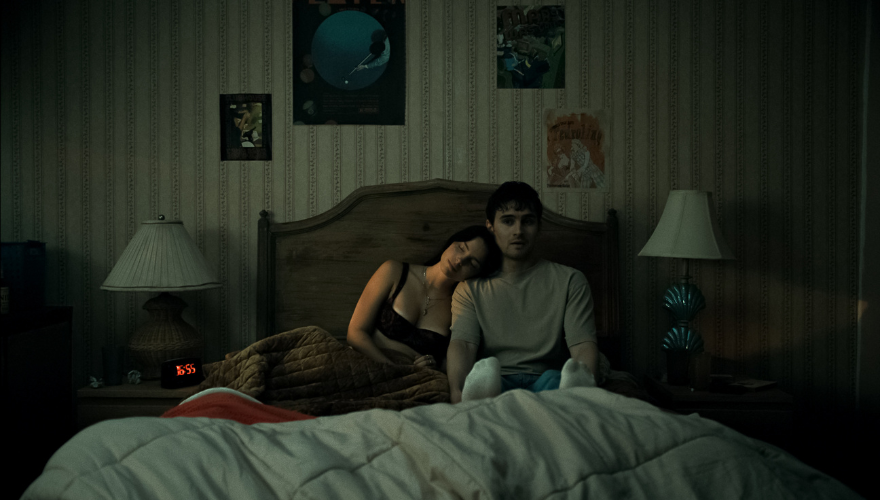


There was a point during LifeHack where I suddenly realized my shoulders had been completely tensed up for almost twenty minutes straight. That is usually a pretty good sign that a thriller is doing something right. Especially one unfolding almost entirely through laptop screens, Discord calls, browser tabs, encrypted chats, security feeds, video games, crypto wallets, and the kind of internet chaos that probably makes every person over thirty feel at least mildly ancient.
Directed by Ronan Corrigan, written by Hope Kemp and Ronan Corrigan, LifeHack takes the now familiar screenlife format and injects it with a refreshing amount of energy, personality, and actual cinematic tension. What initially sounds like a gimmick slowly evolves into something surprisingly immersive. Four online friends attempt to pull off a massive Bitcoin heist targeting a tech billionaire, only for things to spiral violently out of control once ambition, ego, paranoia, and the uglier corners of the internet begin colliding.
And honestly, it is pretty damn fun.
The screenlife subgenre has had an interesting evolution over the last decade. Films like Searching and Missing proved that stories told entirely through screens could be more than just novelty experiments. They found genuinely inventive ways to create suspense and emotional momentum through modern technology. At the same time, there have also been plenty of entries that treated the format like a cheap horror trick rather than a storytelling language.
LifeHack comfortably lands closer to the stronger end of that spectrum.
What makes the film work is that it understands something many cyber thrillers forget. Technology itself is rarely the most interesting part. People are. The hacking, spoofing, encrypted files, and crypto jargon all create texture and momentum, but underneath it all this is fundamentally a story about friendship, insecurity, recklessness, and young people trying to outsmart a system they feel permanently locked out of.
That gives the film a surprising emotional grounding beneath all the frantic clicking and digital chaos.
The setup is simple. Four Gen Z friends scattered across different locations spend most of their lives online together. Gaming, joking, sharing music, arguing, venting. Eventually, they stumble into a plan to rob a billionaire’s crypto wallet. Part rebellion. Part greed. Part boredom. Part “why not?” logic that only really makes sense when you are young enough to still believe consequences are theoretical concepts.
Naturally, things go very wrong.
What impressed me most about LifeHack was how committed it remains to the screenlife format without constantly cheating. So many films eventually abandon the concept halfway through or awkwardly cut into traditional filmmaking once things become more complicated. Here, Corrigan keeps the audience trapped within screens the entire time. Laptop cameras. Shared screens. Surveillance feeds. Video chats. Browser windows. The movie never physically escapes into the real world, and weirdly enough, that restraint becomes one of its greatest strengths.
It creates a constant feeling of claustrophobia.
The editing here deserves enormous credit. This kind of filmmaking lives or dies entirely through rhythm, pacing, and visual organization. The film constantly bombards you with information without becoming incomprehensible. Notifications, side chats, gaming interfaces, Spotify playlists, file transfers, security systems, background tabs, and rapidly escalating panic all exist simultaneously on screen, yet the storytelling always remains surprisingly clear.
And when the tension kicks in, it really kicks in.
There is a sequence involving physical infiltration during the heist that genuinely had my theater holding its breath. It taps into that classic heist movie pleasure of watching highly specific plans slowly unravel in real time. The beauty of the sequence is that it understands the biggest vulnerability in any cybersecurity system is not actually technology. It is people. Human error. Human panic. Human ego.
That idea runs throughout the entire film.
The performances also help tremendously. One of the reasons many screenlife movies fail is because they forget audiences still need compelling characters beyond the format gimmick. Here, the young cast brings a natural chemistry that makes these friendships feel believable. The banter feels authentic without trying too hard to sound “internet cool.” These genuinely feel like kids who have spent years online together.
There is also something refreshing about how specifically Gen Z this movie feels without constantly mocking or patronizing its own generation. Discord servers, TikTok humor, red pill edits, gaming culture, livestream anxiety, crypto obsession, digital loneliness, parasocial identity. The film understands this ecosystem because it clearly comes from people who actually inhabit it.
That authenticity matters.
At times, LifeHack almost feels like a time capsule of internet culture from the late twenty tens and early twenty twenties. And I mean that in a good way. Watching all these familiar online behaviors projected onto a massive theater screen creates a strange feeling of nostalgia and discomfort simultaneously. There is humor in it, but also something slightly depressing about realizing how much of modern life now exists entirely inside glowing rectangles.
The film taps into that unease really effectively.
Tonally, Corrigan balances things well for the most part. The movie knows when to lean into comedy and when to tighten the screws. Some of the funniest moments arrive through absurdly mundane online interactions, while some of the most stressful scenes involve nothing more than waiting for a file to upload or praying somebody does not click the wrong button. And somehow, it works.
Now to be fair, the film is not flawless. There are moments where credibility stretches a little thin, especially once the operation becomes larger and more elaborate. Certain plot developments move faster than they probably should. A few emotional threads could have used more breathing room. And like many screenlife projects, there are occasional moments where you instinctively think, “Why are these people still recording this?”
But honestly, the movie earns enough goodwill through sheer momentum that most of those issues become easy to overlook.
What I appreciated most though was the film’s punk rock energy. There is an anti-establishment spirit running underneath all the cybercrime chaos that gives the movie personality beyond its genre mechanics. This is very much an “eat the rich” story filtered through internet generation exhaustion. Young people weaponizing the very systems they grew up inside. Not because they are noble heroes, but because they are frustrated, reckless, curious, and tired of watching billionaires treat the world like a rigged arcade machine.
That underlying anger gives the film bite. More importantly, it gives the film identity.
By the time LifeHack reached its final act, I realized something pretty unexpected. I was not thinking about the gimmick anymore. I was simply locked into the story. And honestly, that may be the biggest compliment you can give a screenlife movie.
Because beneath all the screens, codes, Discord calls, and crypto chaos, LifeHack succeeds where it matters most.
It works as a thriller first. Everything else is just the interface.
LifeHack is now in Theaters.