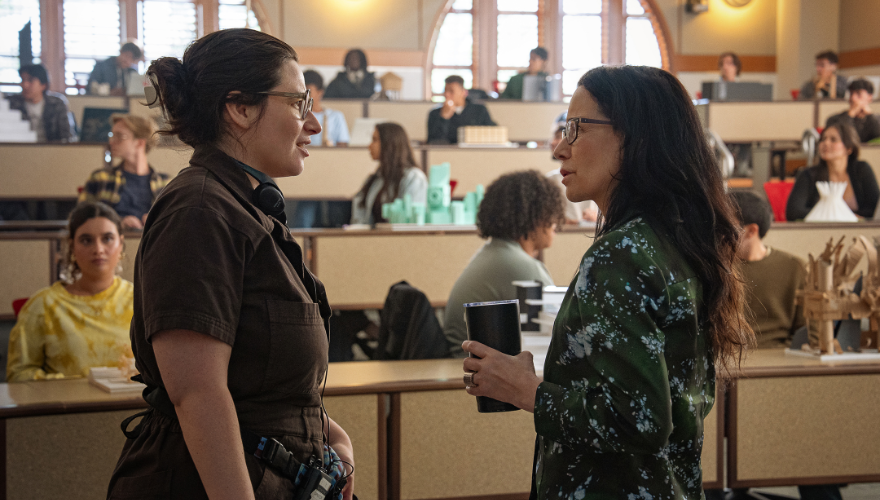


The Feeling Between Past and Present: A Conversation With ‘Jay Kelly’ Co-Writers Noah Baumbach and Emily Mortimer
Co-writers Noah Baumbach and Emily Mortimer discuss their approach to writing the screenplay, the film’s exploration of life stages and the importance of friendships.
Jay Kelly follows famous movie actor, Jay Kelly (George Clooney), as he embarks on a journey of self discovery confronting both his past and present, accompanied by his devoted manager Ron (Adam Sandler). Poignant and humor filled, epic and intimate.
Jay Kelly. Cary Grant. Jay Kelly. Gary Cooper. Jay Kelly. Clark Gable. Jay Kelly.
Artists, performers, actors, heck even writers, chase an ideal, while running away from our past. Some ideals are shaped by how we present ourselves so that folks perceive you as this perfect, untouchable, incredibly specimen of a human being. A one of a kind. And hopefully, uttered in the same breath as past greats – remembered.
The latest film directed by Noah Baumbach and co-written with Emily Mortimer, plays with that idea of being remember, what memories are worth remembering and which ones do we wish we could just forget. Simply said. Perhaps. But how do you execute that visually. Well… watch Jay Kelly. Actually, I highly suggest you read their screenplay, too. Because they managed to both get it down on the page and up on the screen. Jay Kelly isn’t perfect. He’s not a great father. Not a great friend. But he adores his fans. And himself. He somehow manages to surround himself with pretty decent folks, like his longtime manager Ron. Who we really feel for (and at most times wish he’d dump this client… but there’s history).
Co-writers Noah Baumbach and Emily Mortimer discussed with Script the character’s existential crisis, their approach to writing the screenplay, equating the opening scene that to an orchestra warming up, the film’s exploration of life stages and the importance of friendships.
This interview has been edited for content and clarity.
Sadie: The scene on the train where Jay is looking at himself and riddling off his name with these screen legends, as an audience member, that hit emotionally for where this guys’ headspace is. And it took me back to the scene with Peter making a sandwich in Jay’s kitchen and he quips, “Pickles don’t expire.” Creating this persona that is Jay Kelly, and creating this journey that we're going with him – how did you initially land on this character?
Emily Mortimer: Well, the character was definitely somebody that was already somewhat in existence when Noah sort of approached me with the idea for the movie. There was, and it's funny, there was one scene... that was that "pickles don't expire" which is also one of my favorite lines from the film, was already a line in the [script]when Noah asked me to write it with him. I felt immediately very kind of both sort of extremely charmed by this character… and drawn to him, as well as feeling like there was something kind of unknowable about him.
Which is, I think, a feeling that continued throughout the writing process and in the finished movie even, which is part his own personal tragedy, in a way, or his cross to bear - maybe tragedy is too heavy of a word for the movie - but that he is confused about his own identity, and has become more and more confused about it as time has gone on, because here's somebody that as his old actor teachers says, ‘doesn't tend towards introspection’ and has become one of the most famous people alive and all of a sudden is having a kind of existential crisis around what his true identity really is.
That moment that you describe where he looks at himself in the mirror and says his name over and over again really... gets to the heart of that. I'm this person. I'm this name that means so much to so many people, but what does it actually mean, and what does it really mean to me? And maybe I can find some solace if I say it many times and link it to other great actors or movie stars... but really, it's just a name and it doesn't really mean anything. I'm happy that that scene kind of resonated for you, because I think it does sort of somewhat get at the kind of the heart of this particular hero's journey.
Sadie: The first 20 pages of this screenplay sings and is such a great read. It’s fluid and so cohesive, especially in the way you introduce key characters and their dilemmas. Once you got that on the page, Noah, then taking it to the next step and putting your lens on it – what was that process like working with your DP Linus [Sandgren] and making sure you keep that fluidity on screen as well?
Noah Baumbach: Yeah, the whole beginning of the movie... it's almost like a musical movement… the whole sequence on the on the set, like going through his death, and then the cutting and the wrapping of the movie. And even after that it keeps going. It sort of has this momentum as it takes him to the trailer. And then there's sort of a moment of when he gets alone for the first time. I think we sort of always thought of that as the end of something, like the ending of a song in some way. [laughs] If there had been a song that accompanied the whole thing, it would almost probably take you through that whole segment. And then we introduce his daughter, and we're sort of in another different energy at that point.
Linus and I, that was sort of I think what partly gave us the idea to do the whole opening in one shot and to keep this flow and movement and this kind of real time feeling to it. It's like loose information that keeps gathering, but some of it means something, and some of it doesn't. And at this point it's up to you to take what you want, and it is like music in that way.
I remember when Emily wrote some of the things from that, just some of the overheard stuff from that opening shot, the stuff about the dry eyeballs that her character actually delivers. It's sort of one of those things that it has no meaning for the movie, but it felt meaningful at the same time. It's like an instrument that's playing on the track...
Emily: I remember you once saying it has the feeling of the orchestra kind of tuning up, or getting ready...
Noah: Or Nick Britell's score there actually has that. It is like the orchestra learning the score, is the background of that as well.
Emily: And that noise as well... the way that Noah shot it, and the way that we intended it as we were writing it too is like the kind of the noise and the mayhem and the chaos that's all around a performer as they're having to try to keep their wits about them before they go on stage or set and deliver the thing that they're being paid the money to do, that everybody's come to see... The kind of the responsibility of being that person, and the work that it entails, and the kind of skill that it entails, as well as the sort of courage and the presence of mind. And despite all this nonsense and whirlwind and noise and kerfuffle, he's having to keep his head screwed on and deliver. And that's what his whole career has been built on the fact that he can. The way that that Noah created that scene in the movie is so cool, because you get to feel that you get to be inside that experience as the viewer.
Sadie: Yeah, absolutely. And Jay’s posse per-se kind of felt like this Greek Chorus following him around. Jay is definitely going on an emotional experience of a lifetime, which he’s either running way from, trying to make up for lost time, or running toward but I do wonder, is it his guilt that he’s chasing?
Emily: I guess that he's at that stage in life that I felt very much I related to as we were writing and I guess that me and Noah, kind of around about the same age, and that moment in in life, where it does almost feel like a referendum, because you've worked long enough and that you kind of know where you are with that, and you can kind of see what you've done. And then if you're lucky enough, you may still have a parent or two who's still alive, but if they're alive, they're old, and you probably have a kid or two who's getting ready to leave home, or has left home, and so you're kind of at this moment where you're just by the very nature of where you are in your life, thinking about those things. Even if you'd rather not, you can't help it. It's kind of hitting you in the face.
I think that Jay is a character who definitely would rather not think about that sort of stuff. But like it or not, it's coming to him. The filmmaking as regards to the way that the kind of memories hit him, he's escaped from his present in only to be chased by his past and almost hit in the face by his past and it feels like he's kind of being ambushed, especially at the beginning by these memories. They're just kind of coming to him... or he's walking into them literally, physically. I think that's what we felt as we were writing that this is a character that doesn't, as I said, tend towards introspection, that doesn't want to think about these things at all.
Sadie: Big fan of films that have ambiguous endings. I’m very curious, what do you think happens to Jay after this tribute and or is that something you’ve intended that audience to paint that picture?
Noah: I think the movie ended for us there also. Maybe Emily knows, but I don't really have any idea. I could speculate, just as anyone could, but I do feel like it's the end of the movie… I think because it's like you said, it's then left for the audience to bring their own experience, their own ideas, their own life into it, and go off with it.
Emily: I think he goes back to work.
Noah: Oh, you really know. [laughs]
Emily: [laughs] Yeah, I think I really know. I just don't think Jay's gonna ever stop working. That's how he knows how to live. And I think he goes back to work with Ron, and it's like nothing happened... that's what I think. Just all these revelations... revelations are never sort of revelations for long. It's like the clouds part, and the light shines through for a second or two, and then you get back to your life, and hopefully something has changed a little bit, or shifted. What else would he do? I think he just goes back to work, maybe that's presumptuous of me. I don't know Jay really, but [laughs] we need him to make another movie or two.
Sadie: [laughs] We do! Ron is a very special character in this film and especially and specifically important to Jay. Obviously, Ron works for Jay, but there’s this friendship, this bond that you’re both rooting for and also feel Ron just needs to get out of – but… he wants Jay to be his friend too. Can you touch on the process of writing this character?
Emily: Writing Ron was such a sort of fun task…I love that relationship... and I love that fight they have at the end, because I think that in every relationship, there is an element, OK yes, this guy is working, Ron is Jay's manager and he's paying him 15% to do his job, and so that is just baked into the fabric of that relationship is this kind of slightly transactional, confusing thing, but I think that's true of most relationships.
The relationship you can have with your parents or your children. Well, you have to have that relationship with them, because they're your parents and they're your children, and you're stuck with each other, like it or not, and... with romantic relationships too... do you really fall in love with that person or the idea you have of that person?
This whole movie is this love story between Jay and Ron, where they both work out that they really want to be each other's friends. And that that's kind of the most definitive the film gets, which is Jay works out Ron is his friend, and he has a friend [laughs] and that's great.
Sadie: Yeah, it's a beautiful thing having a friend like that. Back to the screenplay. The fluidity of the read, I think lends to how you’re not writing to industry formatting standards, in that you’re not using slug lines or standard scene descriptions. Was that intentional, in that you were already thinking visually how you’d direct this?
Noah: In terms of not using the sort of the interior exterior slug lines.... it felt right for the movie. I think, for all the reasons you've mentioned, it's that there's a certain kind of momentum that like, once you're in it, you're kind of tumbling forward in a way. I do feel in the read, when you have interior... they're there really for production. They're not really there for the read. I felt like, well, why couldn't we still tell you where you were in a way that felt more organic to the telling of the story, and not highlighting itself that way. Because, of course, when you watch a movie, you can start on a close up of something, and you don't know where you are. You don't know you're in the parlor, yet. [laughs] But if you write 'interior parlor, close on a hand' you're in the read, you're having a different experience than you are in the film.
I don't read a lot of scripts, because I only direct what I've written. I don't really know in some ways, how other people do it, except for the ways we've been told, and the formatting that comes in the programs. I don't know if Emily felt this when we were doing it, but I felt it was also a way to kind of free us up and not feel like we had to do it one way or another way. Which also felt right for this story in particular, I think it was a combination of both.
And the memories were part of that, because I think we never wanted the experience of going into the past to feel like a break in the action or a reflection. We didn't want it to feel gentle. It isn't somebody sits back on a plane and thinks about their past and looks out of the window pensively. And then we cut to their paper route when they're 12, [laughs] and it's black and white now. It felt like it should be something more physical. So that's sort of where we ended up on it.
The formatting of the script, and the style of the script, the writing of the script, it folded in in a way, so it didn't feel like, as you said, it didn't feel like we're doing anything different. The past and the present live concurrently in the movie. In a way, the past are like headwinds for Jay... he's kind of trying to outrun his life, and we know that's not possible. And so, these are reminders, these are things that... his unconscious is kicking up for him, that he's not in control of. The feeling would be as if it's just on the other side of that door, or in the back of the plane, or in the reflection in the mirror in the train bathroom, or wherever we are, that these things just are there, and they come to them the way memories occur to us. Or why the cursed way why certain tastes or smells or change of season, or all these things that kick up these things for us that we're not in control of. It's a feeling... It's an emotion. That was what we were trying to get at in the telling and in the script.
Jay Kelly is now streaming on Netflix.