

‘Dead Man’s Wire’ Review
When the System Screws You, Take It to Live TV with a Shotgun
Gus Van Sant is finally back, and the first thing you notice about Dead Man’s Wire is just how much fun he is having with it. Based on the astonishing true story of Tony Kiritsis in 1977, this film chronicles a man who, feeling cheated by his mortgage broker, takes a shocking step: wiring a shotgun to himself and his victim, demanding a multi-million dollar payout and a personal apology while turning the event into a televised spectacle. What could have been grim and oppressive becomes a playfully chaotic crime thriller with comedic undertones that are so bizarrely entertaining you find yourself laughing even as you flinch.
This is essentially a story about Luigi Mangione. Van Sant approaches it with the care of a formal homage to 1970s thrillers while also presenting a timeless portrait of how extreme behavior can be championed when a system is stacked against you. Capitalism, as this story illustrates, is ruthless, and the only thing the public gets out of it is a media circus. Skarsgård is the undeniable heart of the film, delivering a performance that is both hilarious and empathetic. He takes Tony’s manic energy and channels it into a character who is equal parts sympathetic and ridiculous, making the audience cheer for a man who has quite literally lost his mind while being treated unfairly. Danny Elfman’s score punctuates every beat with playful menace, giving the film a musical swagger that keeps the momentum high.
Even though the story is nearly fifty years old, it resonates just as sharply today. Every now and then, we are confronted with similar headlines, and each one is a reminder of how little has changed or how much worse things have gotten. Van Sant’s film captures that perfectly. Even the actors with limited screen time are impeccably cast, lending authenticity to a story that could have easily felt like a farce. The production design, costume department, and camera work are extraordinary. Every frame feels tactile and lived in. You almost feel like you are watching archival footage of the 1970s, a period recreation that is so convincing it could easily be mistaken for a documentary.
Van Sant’s direction is both loving and playful. He leans into the absurdity of the real story without losing sight of the tension inherent in a hostage situation. The film is suffused with the late 70s aesthetic, and the period details are immaculate, from the grain of the film stock to the authentic hairstyles and wardrobe. The cinematography captures the tight confines of Tony’s apartment, the strange choreography of a man attempting to navigate chaos while on national television, and the odd humor that surfaces in the most tense situations. Van Sant clearly understands the power of visual storytelling and never underestimates the audience’s ability to notice details.
Bill Skarsgård as Tony is the revelation of the film. His performance is astonishing in its unpredictability and depth. He is part comic, part tragic, part everyman pushed beyond his limits. Every line, every pause, every twitch of his body feels intentional. Tony’s flailing, chaotic energy is balanced by an unexpected tenderness in moments when he interacts with his hostage, played by Dacre Montgomery. Montgomery does not have a ton to work with but still manages to give his character depth, portraying a man caught between duty and self-preservation. Their chemistry, often awkward and unintentionally funny, is one of the most engaging aspects of the film.
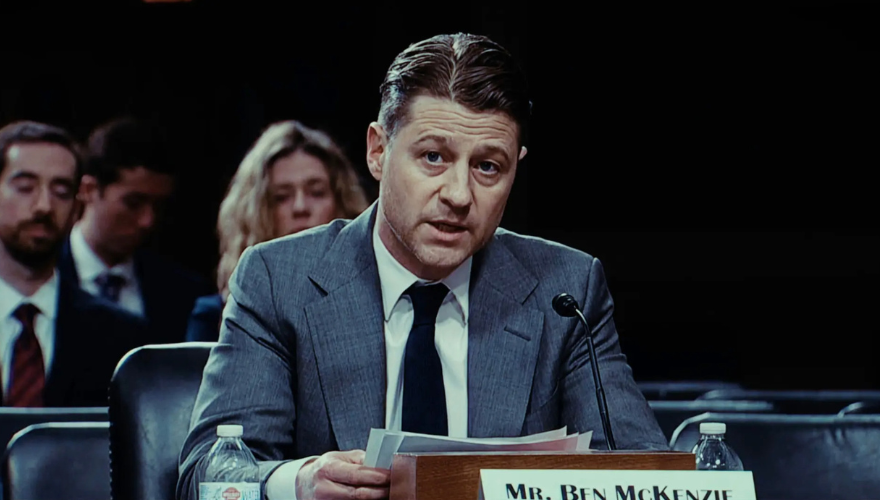
Al Pacino, though present in only a few scenes, is unforgettable. He plays a patriarch of the mortgage company with the right mixture of menace and absurdity. His performance is a wink to the audience, clearly recalling his iconic work in films like Dog Day Afternoon, and yet it never feels self-indulgent. Colman Domingo also shines as the charismatic voice of a local radio DJ who becomes an accidental confidant and cheerleader for Tony. His presence adds an element of charm and unpredictability that elevates every scene he appears in. And then there is Cary Elwes, nearly unrecognizable in his role, yet perfectly cast to fill in the gaps, grounding a story that could have easily become too farcical.
Van Sant wisely keeps any psychological analysis minimal. Empathy is not the goal here. The film is a peculiar satire of a society that allows people to be exploited and then applauds them when they react in extreme ways. This is especially evident in the way the film portrays the media circus surrounding Tony’s actions. Every news broadcast, every camera angle, and every overheard conversation serves to remind us of the spectacle of injustice, turning a violent act into a form of perverse entertainment for the public. The absurdity of it all is at once hilarious and unsettling, a testament to Van Sant’s skill as a director who can balance tone with precision.
While the film plays with comedy, it does not shy away from tension. There is a constant undercurrent of danger, especially in scenes where Tony improvises his plan or interacts with law enforcement. These moments are balanced with comedic beats, often coming from Tony’s flustered attempts to manipulate a situation that is clearly beyond his control. Van Sant makes excellent use of period techniques, including freeze frames, cross-cutting, and analog video textures, to heighten both the humor and suspense. Watching Tony maneuver through his elaborate plan is like watching a man teeter on the edge of disaster, and it is impossible not to be captivated by every move.
Dead Man’s Wire is not without its flaws. The narrative does lose some steam towards the middle, and some sequences are more lighthearted than they probably should be, which slightly undercuts the tension. Yet even these moments feel intentional. The film understands its own tone and uses humor as a counterbalance to what could otherwise be a bleak tale. By the end, any slow patches are overshadowed by the sheer charm of the performances, the meticulous attention to period detail, and the absurdity of the central story.
Ultimately, the film is about justice and the little guy taking on a system that has long ignored him. Tony Kiritsis is not a perfect hero, but he is someone viewers can cheer for because his plight is rooted in real grievances that resonate just as much today as they did in 1977. Van Sant captures the frustration, the absurdity, and the occasional poignancy of a man who has been wronged and will go to almost any length to make himself heard. It is a timely reminder of the inequalities embedded in our society, and how the desperate measures of an individual can serve as a mirror to larger societal issues.
The technical aspects of the film are also outstanding. Arnaud Potier’s cinematography is a highlight, making every frame visually striking without being self-indulgent. The production design immerses the viewer completely in the 1970s, and Austin Kolodney’s writing keeps the narrative moving with energy and flair. Editing is tight, keeping the pacing brisk, while Van Sant’s direction allows the actors room to fully inhabit their characters. Every choice feels deliberate, from the lighting to the camera angles, all contributing to a film that is as visually captivating as it is narratively engaging.
By the time the credits roll, it is clear that Van Sant has successfully returned to form. This is a playful, thrilling, and incredibly funny true crime story that never loses sight of its human elements. It is also a testament to Bill Skarsgård’s talent, who manages to create a character that is completely unhinged and yet deeply sympathetic. The supporting cast, including Dacre Montgomery, Colman Domingo, Al Pacino, and Cary Elwes, all contribute to a rich tapestry of performances that keep the film grounded and entertaining.
Dead Man’s Wire is a triumph of style, tone, and performance. It is a story that feels both nostalgic and urgent, a reminder that history often repeats itself and that the injustices of the past are never too far removed from the present. Gus Van Sant has crafted a film that is both a loving homage to the thrillers of the 1970s and a razor-sharp commentary on the nature of power, greed, and media spectacle. It is funny, it is tense, and it is deeply satisfying. Bill Skarsgård is a revelation, Van Sant is at the top of his game, and the film as a whole is a must-watch for anyone who appreciates cinema that is both entertaining and thought-provoking.
In the era of Luigi Mangione, Dead Man’s Wire reminds us that before there was a Luigi, there was Tony Kiritsis. One man, a shotgun, and a very public demand for justice. This film celebrates the chaos, the humor, and the humanity of an extraordinary story that still resonates today. Gus Van Sant is back, and the world is better for it.
Dead Man's Wire will release in select US Theaters on December 12, 2025 with a limited release in select Theaters on January 9, 2026, before releasing in Theaters everywhere on January 16, 2026.