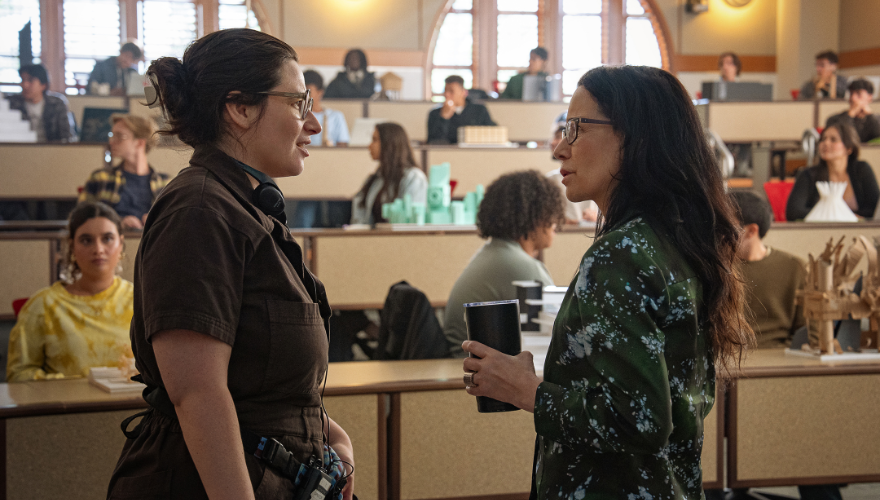


City as Character: Shih-Ching Tsou Discusses ‘Left-Handed Girl’
Shih-Ching Tsou discusses her first solo-directing journey, collaborating with Sean Baker, capturing the electrifying Taiwan night markets, being inspired by Dogma 95 films and connecting audiences with interesting stories.
In Shih-Ching Tsou’s first solo directed feature film Left-Handed Girl she deals with generational trauma, cultural superstitions, and urban stress. The characters of Shu-Fen (Janel Tsai), I-Ann (Shih-Yuan Ma), and I-Jing (Nina Ye) are the central focus of the story, but the Taiwanese night market where the mother owns a noodle shop is also a vibrant character in the story, helping to shape the narrative and affect the characters. All of the actors were familiar with this hotbed of activity. “The night market is such a big community, it’s an activity most people do. A lot of people go there, sometimes every night, for dinner. It’s a big part of the culture in Taiwan,” says Tsou.
Tsou, a native of Taiwan who’s now based in New York, has been developing this project for over twenty years. It’s been a labor of love and a passion project. Her previous films have been done with her collaborative partner, Sean Baker (Anora, Tangerine). She co-directed Take Out (2004) and served as a producer on Tangerine, The Florida Project, Starlet, and Red Rocket. After meeting in editing class back in 1999, she and Sean bonded over their love of the Dogma 95 movement and its “Vow of Chastity” principles. Tsou credits the movement with influencing her style.
“I feel like that style is so touching. It’s so simple. The story is the center. They strip out all the fancy music and special effects and just focus on story,” she tells Script.
The Playground of the Night Market
When Tsou was a little girl, she used to visit night markets. They were like a playground for her. “They’re very colorful and noisy,” she says. This diorama of sights, sounds, and smells proved to be a playground for her as a filmmaker as well. Using the iPhone 13, she was able to quickly and easily traverse the marketplace, capturing its electric energy through mobility.
Sonya Alexander: Had you used an iPhone before to film any other projects?
Shih-Ching Tsou: Yes, we filmed Tangerine ten years ago using the iPhone 5. The reason to shoot the film with an iPhone isn’t because of the budget. I wanted to capture the real night market. I wanted to shoot it almost documentary style, where we hide the crew. We wanted to capture everything in real time in the night market.
Sonya: What makes Sean Baker the ideal collaborative partner?
Shih-Ching: When we met back in 1999, we started talking about wanting to make something like a Dogma 95 film. The Left-Handed Girl is actually the first idea I told him. When I was in high school, my grandfather told me the left hand is the devil’s hand. Don’t use it. I told Sean about that. In 2001, we went to Taiwan to try to find a story, to try to come up with an idea. We realized it was too big of a project to start so we went back to New York and we made Take Out. That was the first movie we made together. $3,000, two-person team. Since then we’ve worked on several other films together. Then, we finally had the money to make Left-Handed Girl.
Sonya: When you first started this project, you weren’t a mother. Now you are. Do you feel your perspective of the story changed at all because of this?
Shih-Ching: It definitely did. My daughter inspires me every day. One of the images in the film is actually inspired by one of her toys. Being a mother definitely gave me a different insight to make this story.
Sonya: What is your process for writing with Sean?
Shih-Ching; When we went back to Taiwan again, in 2010, Take Out was in theaters, so we thought that was the time to finally make Left-Handed Girl. We stayed in Taiwan for a month. During the day we sat at home writing stories together. I would tell him stories and he’d type them into his computer. At night, we went to visit all of the night markets in Taipei. It was really fun, especially for him because he had never lived in Taipei before. We also did location scouting. We also tried casting. At the time, we ran into this little girl when we were filming. She was just like I-Ching, running through the marketplace on her own. We found her mother and I became friends with her. We did a proof-of-concept video clip with the girl. With that clip, we went to two different film markets to try to find funding. That was the process in 2010 during that one month.
Sonya: What was the thing that finally jump started the production?
Shih-Ching: In 2021, we went back to Cannes in the main competition with Red Rocket. We met with a French distributor. Then we sent them the script. They were the first people who told us they’d support us.
Sonya: You worked with child actors on The Florida Project?
Shih-Ching: Yes, we did.
Sonya: And now this film. What are the challenges of having kids on set?
Shih-Ching: It can be very chaotic but we had very helpful crew members. They sat with the kids and tried to tell them what to do. At one point, there’s a kindergarten class in the night market. That was a fun day. That was actually my daughter’s kindergarten class.
Sonya: The character of I-Ann works at a Betel Nut store. What is Betel Nut?
Shih-Ching: It’s a stimulant. It’s a natural fruit. When you chew on it, it keeps you awake. It’s like chewing tobacco.
Sonya: If you owned something at a night market, what would it be?
Shih-Ching: A juice stand. It’s very healthy and very easy to make.
Making Movies
One of Shih-Ching’s goals as a filmmaker is to capture human interaction and that connects with people in different ways. Traveling the globe with Left-Handed Girl, she encounters many interesting stories and locales. However, for her next project, she’d like to keep it close to home.
Sonya: If you were given an unlimited budget, what would your next project be?
Shih-Ching: I want to go back to New York to make a film in my neighborhood. I live in the East Village and I feel like there are so many stories there. I’d really like to make another movie in New York.
Sonya: This was your first time directing solo. What was hardest about it?
Shih-Ching: After we finished the film, I had to be the face of the film. I had to go out and talk to people. I had to communicate my ideas. In the beginning, this was very challenging because I’m a very low key and behind-the-scenes kind of person. I had to get used to it though.
Sonya: What would you describe your style as?
Shih-Ching: I’m very laid back and I really trust my actors. We didn’t have a formal rehearsal with all the actors for Left-Handed Girl. I asked all the actors to bring their own life experience into their characters. When everyone’s ready and they come to set, they interact and collaborate to bring the roles to life.
Sonya: What's your biggest takeaway from this experience?
Shih-Ching: That the timing, the pace, of every film is so different. I think I learned to be patient. You have to trust yourself and the timing.
Sonya: When you’re writing, solo or with someone else, do you do things that get you in the mood or headspace for writing?
Shih-Ching: I like to do a lot of research. If most stories aren’t based on some sort of facts, they look fake.
Sonya: Do you storyboard?
Shih-Ching: I don’t storyboard, but I definitely do a lot of research. I talk to people and observe them.
Sonya: What advice would you give to aspiring filmmakers about getting their first project done?
Shih-Ching: You have to really trust yourself. Don’t follow trends or what is popular right now. If you want to make a good movie, the movie has to have a heart.
Left-Handed Girl is currently streaming on Netflix.

Sonya Alexander started off her career training to be a talent agent. She eventually realized she was meant to be on the creative end and has been writing ever since. As a freelance writer she’s written screenplays, covered film, television, music and video games and done academic writing. She’s also been a script reader for over twenty years. She's a member of the African American Film Critics Association and currently resides in Los Angeles.