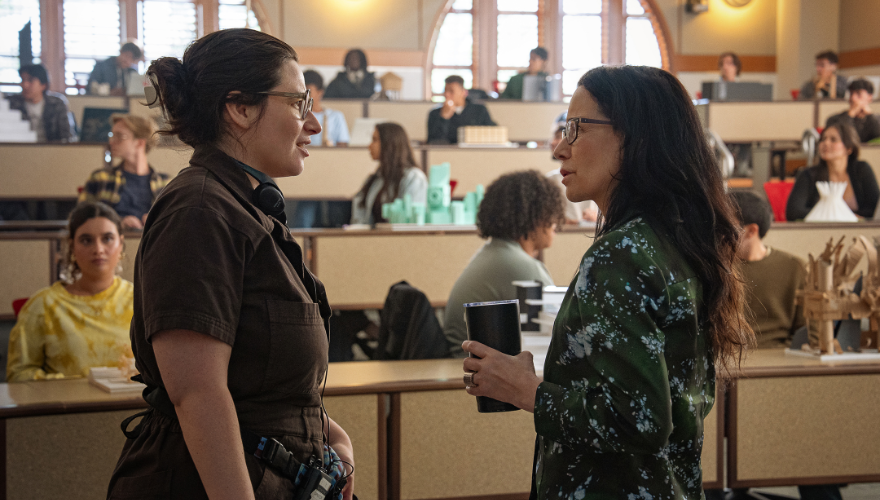


From Book to Screen: Adapting ‘Hamnet’ with Author and Co-Screenwriter Maggie O’Farrell
Maggie O’Farrell discusses her inspiration for writing ‘Hamnet,’ her collaborative process with co-writer and director Chloé Zhao, and the necessity of making interior emotions exterior.
1580 England. Impoverished Latin tutor William Shakespeare meets free-spirited Agnes, and the pair, captivated by one another, strike up a torrid affair that leads to marriage and three children. Yet as Will pursues a budding theater career in far-away London, Agnes anchors the domestic sphere alone. When tragedy strikes, the couple’s once-unshakable bond is tested, but their shared experience sets the stage for the creation of Shakespeare’s timeless masterpiece, Hamlet. From Focus Features and Academy Award® winning filmmaker Chloé Zhao (Nomadland, The Rider) comes a sensitively observed, magnificently crafted tale about the complexities of love and the healing power of art and creativity.
Based on Maggie O’Farrell’s award-winning novel Hamnet and adapted for the screen by Chloe Zhao and O’Farrell.
There are movies that live with you. That move you. That make you feel emotions so incredibly heightened that it can be both wonderful and terrible all at the same time. I had and continue to have that emotional reaction to Darren Aronofsky’s film Requiem for a Dream. It’s a solid film, but only rewatchable maybe, once a year, if that. There are a handful of filmmakers that sometimes get to the cusp of taking their audience on that emotional journey, but most filmmakers shy away from truly tapping into their vulnerability as storytellers. But… then there’s Chloé Zhao. She never seems to falter or hold back. She invites the viewer in, immerses them fully with a landscape, a person being fully themselves and all the intricate yet subtle details in between, as well as the good, the bad, and the ugly.
Hamnet. It lives, it breathes, it gets under your skin, it permeates, it wrestles with your emotions like no other. Hamnet is a film I think about quite often. It got under my skin. It made me feel my feelings. It’s a film I desperately want to rewatch, but it may be one of those I can only handle once a year. A solid film. A beautiful, moving, sweeping, grounded, emotionally staggering film. The writing is top notch. The acting, on another level. The production and costume design – lived in. And that’s just the film.
The book, from which it is adapted of the same title, offers the same emotional whirlwind, as I’ve been told by many a fan of the book and author Maggie O’Farrell. I’ve yet to read the book, because, as I’ve mentioned to Maggie during our conversation, I’m not quite ready to be emotionally destroyed again… but I do look forward to reading her beloved novel.
Maggie O’Farrell discussed with Script her inspiration for writing Hamnet, emphasizes the importance of research during the writing phase, her collaborative process with co-writer and director Chloé Zhao, and highlights the challenges of adapting her book to a screenplay, the necessity of making interior emotions exterior, and the impact of Chloé’s unique filmmaking style.
And dear reader, when you do go see this film, may I suggest you prepare by bringing a box of tissues with you and carving out at least four hours post-viewing to process your emotions in a quiet and comforting place of your choice.
This interview has been edited for content and clarity.
Sadie Dean: Before you and Chloé [Zhao] brought these characters to screen they lived with you first – how did you first find this story and the research that came with that?
Maggie O’Farrell: I was really lucky in that I had a really excellent literature teacher at school. And when I was 16, we were studying the play, and he told us - and I loved the play, by the way, it got really under my skin - and he told us in passing one day that Shakespeare had a son who died aged 11, and he'd been called Hamnet. And Shakespeare had gone on four or so years later, to write the play Hamlet.
And even though I was really away from being a writer that time, I knew that this was hugely significant. No one would casually name a play and a character and a ghost after your dead son. I knew that it was something really, really significant in his life. So, its kind of always stayed in me, and I kept thinking about.
I had a kind of an idea to write a novel about it, and I kept circling around it, and I would do a bit more research, and I'd get more books about Shakespeare, and I would kind of pull away from it and I think, 'Who writes a novel about Shakespeare?' [laughs] I ended up writing three other books, actually, instead of writing Hamnet.
I hadn't started the story in the right place in there. I hadn't really found the voice and the time. And then I just decided one day, I thought, actually, I have to start with him. I have to start with the boy. And so, I wrote the sentence that “a boy is coming down the flight of stairs,” and I don't know, some reason it just kind of unlocked. And that was just the right time in my life and the right time in the story that I'd started it...
The research - I really love the research. It's not really a stretch for me, because my children call me a "Neek". I don't know if you've ever heard the word, I have teenagers and a Neek is apparently, I'm told, a cross between a geek and a nerd. [laughs]
Sadie: Best of both worlds. [laughs]
Maggie: [laughs] Yes, certainly. I'm very proud of that label. [laughs] I just love reading. I read loads of biographies of Shakespeare. I read lots of historical tracks of the time. The thing is, you know, whenever you're writing a novel, you always are going to meet or any kind of creative process, whether it's a script or sculpture, you're always going to meet a series of brick walls. But if you're writing a novel that's set in the past, and it requires a lot of research, it's actually quite nice, because you hit a brick wall like you always do. And instead of kind of spending a week tearing your hair out, you just think, ‘Oh, I'll just go to the library and read some more books.’ [laughs]
Sadie: Going from that, because as writers, we can go down endless rabbit holes of research, and then it's like, OK, when do you start writing? So, in this case, going through, I'm sure, endless hours and days and months and years of research, when did it click and you knew it was time to put pen to paper?
Maggie: Well, actually, I tend to do the research at the same time as writing. I think there's always a period when you're about to start writing a book, and it's as if you have lots of antennae out and they're all picking up signals from all over the place. And I did do a lot of research then, and I was reading biographies of Shakespeare, but actually, I've always really believed that you don't really know what it is you don't know. You're not actually in the work until you're actually doing it.
Sadie: So true.
Maggie: So even, actually, in the first scene where Hamnet comes down a flight of stairs, and I have him falling on the floor and on his knees. And I remember at that point, it's probably three paragraphs into the novel, I lifted my hands from the keyboard, and I thought, what is a floor from in a house in the 16th century made of? You've fallen on your knees. How much does it hurt? Is it stone? Is it wood? Is it covered in rushes? Is there a rug? I had no idea.
And I remember at that point thinking, OK, I need to go to Stratford. There was a point in the book, ‘OK, I'm going to write a scene set in a field where there's a sheep farmer, lambing.’ I mean, I don't know anything about lambing, but luckily, my sister is a vet, so I asked her, and I said, [laughs] 'OK, tell me about lambing, what happens exactly?' So, you don't really know until you get there.
Sadie: You can research at the same time as you're writing, and you'll get to the end a lot faster – [readers and writers take note – it can work!] Teaming Chloé, who is a writer, director and has a very specific lens – what’s so great about her style is that really pays attention to the smallest details from setting, wardrobe, atmosphere to character specifics. What was the adaptation process like between the two of you?
Maggie: It's really interesting, especially because, as you'll know, the life of a novelist or a writer is, by nature, very solitary. And I love that, don't get me wrong. It was really interesting. Especially, it was the first time I've ever collaborated with anybody on a creative process, and I was really pleased. I was thrilled, actually, when I heard that she was interested in working on adapting the book, because I knew straight away, having seen her films, that she wasn't going to make a kind of antiseptic costumey costume drama, [laughs] you know the kind I mean.
There's several times in the film, you somehow see Jessie's [Buckley] hand or Paul's [Mescal] hand, and its always dirty fingernails. [laughs] And it makes me so happy, because I love the fact that detail is there that they don't look like 21st century people dressed up and they're all pristine. I love the fact that they look kind of dirty.
And once there was a room where, when I visited the set the first time… lots of people sewing these incredibly meticulous kind of lace shirts or caps or something with these beautiful stitches and recreating these Elizabethan costumes. On the end of this room, there was another smaller room where, basically they just beat up the clothes and they hit them with chains and branches, covered them in mud, kind of brushed it off. And it was, in one way, it was heartbreaking. 'Oh my god, they've spent weeks working on this beautiful item of clothing.' [laughs] I knew that Chloé was going to make a kind of conventional costume drama. And I was really pleased, because I didn't want that for the book.
I also knew that she didn't come necessarily from a background that was steeped in Shakespeare. And I think that was a real strength, because she was never going to make a kind of idolatrous film about Shakespeare. Don't get me wrong, I love Shakespeare, but there are lots of films that idolize him, and that's fine. They do their thing, but I thought this needed a different angle, Chloé was the woman for the job.
Sadie: Yeah, absolutely. And going off of that, what were the biggest changes, or maybe just creative challenges that became creative miracles during that process?
Maggie: It's a really interesting process because, you know, a novel is... 350 pages, and if you sat down and read it cover to cover, without moving from a chair, it would probably take you, I don't know what, eight, nine hours, maybe. But, of course, the film, it's got to be 90 minutes or two hours. So, there's an awful lot of distillation that needs to happen.
And I think of the process, it kind of happens in the shape of an hourglass. So, you have this large novel that's quite a lot of it is interior and very detailed historically. And then you have to distill it right down to its absolute pith of a 90-page screenplay. So, it's tiny at that point. And then I was able to watch Chloé building it out again to something different. So, in essence, it's the same thing, but actually it's a different beast and a different animal, which it should be.
There would be no point in making a film that was a replica of a book. The first task was, which is hard, is to cut it down. There's an awful lot that is in the book that can't, by nature, be in the film. Details about Shakespeare's brothers and sisters, for examples, are lost, and a bit more about his parents. That's the way it goes, and it has to happen. So, it was fascinating.
And also, Chloé and I, we're very different personalities, but I think we have quite complimentary skills, in a way... a lot of the film, a lot of the script was written well, I live in Scotland, so I'm usually in Scotland or Ireland, and she was actually living in California, I think, at the time. So obviously there was, you know, a big-time difference between us. [laughs] She's a very good leaver of voice notes. So often I would wake up in the morning, and I would switch on my phone, and it would just go, 'ping, ping, ping, ping' [laughs] and my husband would kind of say, 'What the hell's going on?' [laughs] I'd say, 'Oh, it's Chloé.' [laughs] And sometimes there would be 13 or 14 voice notes on my phone, and some of them, they vary in length between a couple of minutes or two or the longest one ever was 58 minutes, because she's quite I think, I mean, I think she wouldn't mind me saying this, because I think she'd admit it herself, but her process of thought often happens by talking. I think she's quite a verbal person and verbal reasoning. And she'll work things out in a conversation with herself, perhaps. Whereas I'm the opposite. I have to work things out on pen and paper.
Obviously, her strength is an incredible genius for filmmaking. And I think maybe what I brought to it was this sort of, I mean, obviously I know the story really well, and the history and the time, my kind of Neek qualities, [laughs]
Sadie: This being the first screenplay that you've written, were there other movies that you were studying or screenplays that you were reading, just to wrap your head around the medium?
Maggie: I always watched films, and I really love them, and Chloé and I had lots of in-depth discussion about the different films, and she's a big fan of Terrence Malick, so she sent me off to watch a lot of Terrence Malick films. And we discovered that we're both massive fans of Wong Kar-Wai, the film director. And we had a lot of conversations about this film, Chungking Express, which is often about touch and physical contact between people, which we were talking about with Hamnet.
Obviously, Chloé is so experienced in writing scripts… it was quite a lot in the voice notes, there's quite, [laughs] quite a lot of back and forth and there's also the idea of you address the macro aspects of the script, which is about the structure. And we had to kind of disassemble the chronology, in a way. I mean, the book it's mostly chronological, but it does flip back and forth in time, which works quite well on the book page, it doesn't translate very well always to the screen.
So, the first job, I think, was a kind of macro-overview of how we could disassemble the chronology and reassemble it chronologically, so that we'd start with the kind of the meeting and the love affair. So, there was that. And then after that, your focus sort of zooms in and then you get down to the micro. And so, I found it was really interesting, because Chloé would say, ‘I think we need to do this, this and this.’ And because I've already got the book and the narrative in my head, I would say ‘yes, but if we cut that element that has a kind of domino effect, and then we don't understand why this character behaves like that.’
There's a lot of that back and forth, and that was mostly on Zoom. And then we kind of got down to nitty gritty, gradually. And then we had to kind of cut quite a lot, obviously, because there's a lot of that distillation going on. I was amazed at how the process changed the whole way through, because it's not really like sitting down and just writing it all the way through. There's lots of different stages and aspects to the process,
Sadie: Having someone to have that conversation with, and that dialogue definitely helps, and having Chloé who can help you navigate those waters too.
Maggie: I was very lucky having a very good guide.
Sadie: There are so many beautiful layers to this film, one of them being the human connection and often most times, those connections are unspoken – it’s a gesture or a glance. It certainly doesn’t hurt that you had some incredible talent playing these characters, but I’m curious how much of that unspoken bond was on the page in the book and that process of carrying it over to the script, before Chloé can bring it life on screen.
Maggie: I suppose one of the other aspects of adapting the screenplay, which I didn't mention before, is that a lot of the book is quite interior, and it's quite descriptive. And one of the jobs we had to do was to make the interior exterior. You can't just expect your audience to understand how someone's feeling just by a close up on their face, although, actually, Paul and Jessie are very good at that to be honest. [laughs]
And in one way, you can do that, which I think one is one of Chloé's strengths as a filmmaker, particularly in Nomadland and she's very good at sublimating a person who is suppressing their emotions, she subtly makes it into the landscape. So, you get Frances McDormand gazing at these incredible stark canyons, and in the prairies. I think that's a brilliant, sort of a hallmark of her filmmaking. And I think that works really well here.
There's the whole objective correlative with Agnes in the forest, and you get those amazing, lush sounds of the leaves and the foliage. And that works really well. But the other thing, I mean, in one way, that was very a complicated process, but in the other way, it was actually very straightforward. So, for example, in the scene at the end where Agnes is in the globe, in the novel, she's on her own, she walks in, her brother waits outside, and she has all this kind of emotional process that she goes through about her son's death, and realizing what the play is in the sense. But in the film, we just very simply, her brother doesn't wait outside, he comes with her so she can tell him, she can vocalize to her brother what it is she's seeing and feeling.
Sadie: Yeah, it works. Having those secondary characters definitely helps in this kind of scenario for the adaptation.
Maggie: Yes, exactly. A very simple device, but it's just the way you translate it onto the screen.
Sadie: This being your first adaptation as a screenwriter, I'm curious for you, what was your biggest learning curve from this process, this experience that you'll carry with you as both as a novelist and now as your new journey as a screenwriter?
Maggie: Oh, that's an interesting question. No one's ever asked me that before. I think the biggest thing I've learned is that actually, novels and screenplays are completely different beasts. And when I did my first sort of pass at the script, I noticed that I had, there's all the kind of dialogue, and then there's the sort of scene set, and mine would be enormous. [laughs] ‘They walk into a room; it's this and this.’ And, no, no, no, no, I've got to forget all the things I learned as a novelist. And actually, you don't need it. [laughs] And then I'd look at what Chloé had rewritten, and it'd just be 'exterior, forest' [laughs] and I'd think, OK I need to get more into that. [laughs] Save all that stuff for my novels. [laughs]
Hamnet is now in Theaters.